


Iran Ceasefire Holds as Tehran Response Awaited to US Proposal
Error: Contact form not found.

 by Reuters and Algemeiner Staff

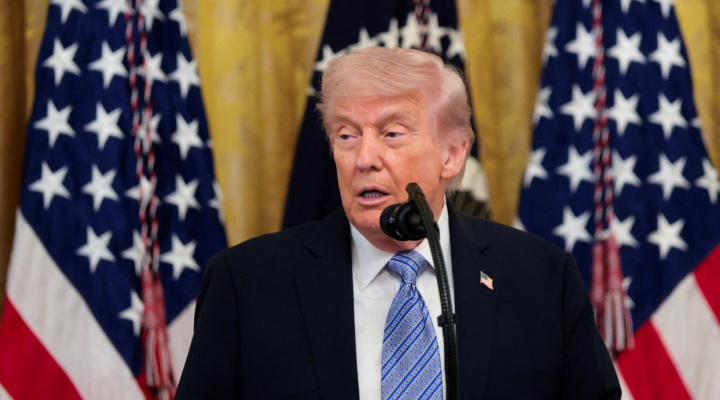
US President Donald Trump speaks during a Small Business Summit in the East Room at the White House in Washington, DC, US, May 4, 2026. Photo: REUTERS/Kylie Cooper
A shaky ceasefire held in the Gulf on Thursday as the United States awaited Iran‘s response to a US proposal that would stop the fighting but leave the most contentious issues, such as Iran‘s nuclear program, unresolved for now.
Iran‘s foreign ministry spokesperson said Tehran had not yet reached a conclusion on the emerging plan, which according to sources and officials centers on a short-term memorandum rather than a comprehensive peace deal, underscoring deep divisions between the two sides.
However, in a statement carried on Iranian state media, the ministry spokesperson, Esmaeil Baghaei, said later: “For the time being, we would not be engaged in the nuclear-related issues.”
KEY ISSUES UNRESOLVED
The proposal would formally end the conflict in which full-scale warfare was paused by a ceasefire announced on April 7. But it does not address key US demands that Iran suspend its nuclear work and reopen the vital Strait of Hormuz, which before the war handled one-fifth of the world’s oil and gas supply.
The proposed framework would unfold in three stages: formally ending the war, resolving the Strait of Hormuz crisis, and launching a 30-day window for negotiations on a broader agreement, according to the sources and officials.
Trump posted on social media on Thursday that he had discussed Iran in call with the president of the European Commission, Ursula von der Leyen and they were “completely united that Iran can never have a Nuclear Weapon.”
On Wednesday Trump, who has repeatedly played up the prospect of a breakthrough since the war began on Feb. 28 with US-Israeli strikes on Iran, struck an optimistic tone.
“They want to make a deal … it’s very possible,” he said later, adding: “It’ll be over quickly.”
Tehran said Iranian Foreign Minister Abbas Araqchi held a phone call on Thursday with Ishaq Dar, his counterpart in Pakistan, which has taken a leading role in mediation efforts.
“We remain optimistic,” Pakistan’s foreign ministry spokesperson Tahir Andrabi told a briefing in Islamabad.
In a sign of the US keeping up pressure, it imposed sanctions on Thursday on Iraq’s deputy oil minister and three militia leaders over what it said was their support for Iran.
Israel, which has also been fighting Iran-backed Hezbollah in Lebanon, said on Thursday it had killed a Hezbollah commander in an airstrike on Beirut a day earlier, the first Israeli attack on the Lebanese capital since a ceasefire there was agreed last month.
A halt to Israeli strikes in Lebanon is a key Iranian demand in negotiations with Washington.
VOLATILE MARKETS
Reports of a possible Iran agreement pushed Brent crude down by 3% to around $98 a barrel, having tumbled nearly 8% on Wednesday, but the rose again to $100.56 a barrel after a Wall Street Journal report said Iran would not allow the US to reopen the Strait of Hormuz with “an unrealistic plan.”
Markets have seen sharp swings during the course of the war during which hopes for a peace deal have repeatedly risen and faded.
A Reuters analysis found well-timed market bets on falling oil prices totaling as much as $7 billion were made in March and April before US President Donald Trump made major announcements on Iran.
Another Wall Street Journal report, citing US and Saudi officials, said Saudi Arabia and Kuwait had lifted restrictions on the US military’s use of their bases and airspace that were imposed after the launch of a US operation to reopen the Strait of Hormuz.
Trump on Tuesday paused a two-day-old naval mission aimed at reopening the blockaded strait, citing progress in talks.
NBC News, citing two unnamed US officials, said Trump decided on the pause after Saudi Arabia suspended the US military’s ability to use a Saudi base for the operation.
A source briefed on the mediation said the US negotiations were being led by Trump’s envoy Steve Witkoff and son-in-law Jared Kushner.
The sources said the memorandum did not mention several key demands Washington has made in the past, which Iran has rejected, such as limits on Iran‘s missile program and an end to its support for proxy militias in the Middle East, including Hezbollah.
There was also no mention of Iran‘s existing stockpile of more than 400 kg (900 pounds) of near-weapons-grade uranium – one of Washington’s central concerns.


