









The Other Iranian Energy Crisis: How Israeli Gas Disruptions Will Cost the Jewish State’s Economy
Error: Contact form not found.

 by Elai Rettig

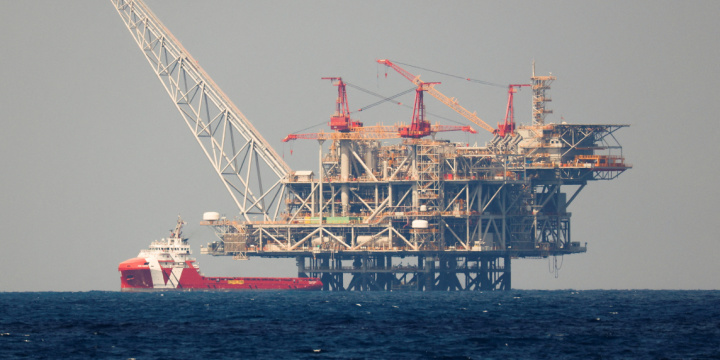
The production platform of Leviathan natural gas field is seen in the Mediterranean Sea, off the coast of Haifa, northern Israel June 9, 2021. Picture taken June 9, 2021. Photo: Reuters/Amir Cohen
The global oil shock created by Iran’s closure of the Strait of Hormuz obscured a second energy crisis that unfolded much closer to Israel’s borders. The month-long shutdown of Israel’s Leviathan and Karish gas fields, caused by repeated Iranian and Hezbollah missile attacks, was the longest gas export disruption since Israel began supplying gas to Jordan and Egypt.
This interruption, the third in the past two years, exposed how dependent Israel’s neighbors have become on Israeli gas for electricity generation, and reinforced a broader strategic lesson for them.
Viewing Israeli supplies as unreliable, Jordan, Egypt and even Syria are now more likely to deepen hedging strategies by expanding renewables, maintaining costly backup fuels, increasing liquefied natural gas (LNG) flexibility, and looking for alternative regional transport and energy corridors. The bright side is that this shift may strengthen the case for IMEC (the India-Middle East-Europe Economic Corridor) by reframing it less as a Europe-oriented transit initiative and more as a domestic infrastructure project for ensuring intra-regional energy security.
The East Mediterranean energy crisis that accompanied the Iran war was distinct from the better-known oil crisis centered on Hormuz. Israel’s wartime safety procedures forced it to shut down its northern Leviathan and Karish gas fields and divert all the gas from its single remaining field (Tamar) to serve the Israeli market at the expense of its export commitments to Jordan and Egypt.
The Leviathan gas field, the largest source of Israeli gas, eventually resumed operations on April, 2, 2026, 32 days after its initial shutdown. Karish opened a week later on April 9, 2026. Together, these closures mark the longest gas supply disruption since Israel began exporting gas to its neighbors, and the third major disruption following the eruption of the Gaza War on October 7, 2023 and the 12-day war with Iran that took place in June 2025.
The importance of these supply disruptions lies not only in their immediate economic effects, but in the fact that they have become recurrent. From the perspective of Israel’s neighbors, the problem is no longer a one-off technical interruption but a recurring pattern of conflict-driven unreliability. That unreliability is concerning because Israeli gas has become structurally important to the region’s power sectors. In 2025, Israel’s natural gas exports to Egypt and Jordan grew by 13%, reaching about 13.2 BCM – an amount that is set to increase significantly over the next 15 years, to an additional 130 BCM, following Israel’s landmark gas deal with Egypt in 2025.
Jordan is especially exposed to this dependence, as natural gas accounts for roughly 68% of its electricity generation and Israeli gas supplies over half of that gas demand.
During the disruption, Jordanian officials moved quickly to reassure the public that the power supply would remain stable, but the emergency steps they took highlighted the depth of the problem.
The National Electric Power Company (NEPCO) had to shift parts of its electricity generation to heavy fuel oil and diesel at a time when oil prices were at a record high and diesel was in short supply worldwide. Jordan had to tap into its limited petroleum stockpiles, import additional LNG cargoes through Aqaba at a higher cost, and reduce gas deliveries to its industry. These measures preserved grid stability, but at significant cost. Jordan’s energy minister stated that substituting diesel for natural gas raised NEPCO’s daily operating costs by about 1.8 million Jordanian dinars (~2.5m USD) and that its strategic reserves were being quickly depleted. The actual fiscal burden is likely to be much higher than that, and does not take into account the additional cost of refilling depleted stockpiles in the months ahead.
Egypt is less dependent on Israeli gas than Jordan, but it too faced a major challenge following the disruption.
Israeli gas accounts for about 15-20% of Egypt’s total gas consumption, and Egypt’s electricity sector is overwhelmingly gas-dependent. Unlike in June 2025, when Egyptian fertilizer producers were forced to halt operations after Israeli gas imports dropped, the steps taken by Egypt during the March-April 2026 crisis point to a broader emergency response.
Cairo increased LNG purchases, relied more heavily on alternative fuel imports, and introduced demand-side conservation measures, including early closing hours for shops, restaurants, malls, cinemas, and other venues. Egypt’s LNG receipts reportedly tripled year-on-year in the first quarter of 2026, from $560 million to $1.65 billion, while its monthly energy import bill rose sharply as it replaced cheaper Israeli pipeline gas with more expensive LNG and liquid fuel imports. This is a striking development for a country that only a few years ago was hoping to leverage its liquefaction infrastructure and offshore resources to become a major gas exporter; it now relies on gas imports to keep the lights on.
Finally, a third casualty of Israel’s gas closures was Syria, which has been involved since early 2026 in a new gas arrangement with Jordan based on Israeli-sourced gas. In January 2026, Jordan and Syria signed an agreement by which the former would supply the latter with up to 4 million cubic meters of natural gas per day.
Jordanian officials stated that gas deliveries to Syria had already begun on January 1, albeit at much lower volumes than agreed, with the goal of helping Syria operate power plants and reduce chronic electricity shortages. When Israeli production and exports were disrupted at the start of the war, gas flows from Jordan to Syria declined or stopped, worsening Syrian power shortages. These developments underscore the extent to which Syria’s fragile electricity recovery is now linked not only to Jordanian infrastructure and Gulf financing but also to the reliability of Israeli gas supplies.
The strategic implication is that Jordan, Egypt, and Syria are now more likely to view Israeli gas through a dual lens, a process that for Jordan and Egypt had already begun in October 2023. Israel remains attractive as a gas supplier because it is geographically close and is already integrated into regional infrastructure, and its gas is often significantly cheaper than liquefied alternatives.
But repeated wartime interruptions make overdependence increasingly difficult to justify. Even if the political will still exists among all parties to continue energy trade, the risk that supply remains susceptible to frequent war-related precautionary closures and wider regional escalation is too serious to ignore.
As a result, neighboring states are likely to intensify their efforts to diversify both fuel sources and generation structures. The most plausible response is not a complete abandonment of Israeli gas but a strategy of hedging against its interruption. That logic is already visible in Jordan’s reliance on backup fuels and LNG capacity and in Egypt’s move toward large-scale LNG purchases and regasification expansion.
But this trend is also likely to expand interest in non-gas electricity sources, especially renewables. Solar and wind do not provide a full substitute for baseload gas generation, but they can reduce marginal dependence on imported fuel and improve resilience in systems where gas is used primarily for power generation. The political meaning of this shift is that the “green energy transition” in the East Mediterranean will no longer be viewed only as a climate or development issue but as a security issue. The repeated shutdown of Israeli gas exports has made that connection harder to ignore.
The second measure Jordan and Egypt will take is to seek more diversified physical supply routes, whether through domestic exploration, additional import infrastructure, or overland pipeline projects that connect Arab markets more deeply to one another. This includes the long-promoted prospect of oil and gas pipelines from Iraq to Jordan, from Saudi Arabia to Egypt, and from Turkey to Syria. This logic applies not only to Jordan and Egypt but also, indirectly, to the wider Levantine energy system. Even where Israeli gas is re-exported, blended, or politically relabeled to find its way to Syria or even Lebanon, the region is still exposed to the same upstream vulnerabilities.
These developments also have implications for how Israel and its partners should think about regional projects such as IMEC (the India-Middle East-Europe Economic Corridor), and whether it is a net win or net loss for Israel itself.
If such corridor projects continue to be presented mainly as infrastructure meant to serve Israeli regional interests and European energy needs, they risk appearing politically detached from the immediate needs of neighboring Arab states. In Jordan especially, the overtly Israel-centered regional branding of IMEC remains difficult to sell.
However, if future corridors are framed primarily as tools for East Mediterranean resilience and not as transit corridors for the West, their logic becomes more compelling. A rail, pipeline, or fuel corridor that improves Jordan’s, Syria’s, Lebanon’s and Egypt’s access to alternative supplies, or that deepens connectivity between Arab states before connecting onward to Israel and Europe, is likely to be more politically palatable and strategically sustainable. In this sense, the repeated gas disruptions strengthen the case for IMEC, but only if it treats the East Mediterranean as an energy-consuming region first and an energy exporting region second. The infrastructure itself will still benefit Israel in the long term, but the corridor’s regional acceptability is likely to depend on its being presented as an intra-regional public good rather than a Europe-facing geopolitical flagship.
For Israel, the lesson emerging from these trends is not that gas exports to neighboring states have lost their strategic value, but that gas interdependence alone does not create durable regional energy security.
Israeli gas exports remain one of the few concrete mechanisms linking Israel economically to the region. If Israel wants its gas diplomacy to retain strategic value, it will need to think less in terms of singular export leverage and more in terms of system resilience.
That means hardening offshore infrastructure, improving redundancy, coordinating emergency arrangements with importers, and recognizing that partner states will actively seek alternatives after each disruption. Leviathan’s planned expansion may increase Israel’s export capacity over time, but larger volumes will not by themselves solve the core problem of ensuring reliability under conflict conditions, as the recent war revealed once again.
For Jordan and Egypt, the likely post-crisis response is not disengagement from Israeli gas but a hedging strategy. Jordan will continue using Israeli supply because it remains economically attractive, but it is also likely to preserve and strengthen backup arrangements through Aqaba, reserve fuels, and renewable generation. Egypt, facing a sharper structural gas deficit, will continue buying Israeli gas but will simultaneously expand LNG imports, regasification capacity, and upstream exploration.
The larger implication is that the East Mediterranean should increasingly be understood not only as a potential export platform, but as an energy-consuming region with growing internal interdependence and shared vulnerability. That shift in perspective should encourage policymakers to ask not merely how the region can ship product outward, but how it can better absorb shocks at home. In that sense, the East Mediterranean gas crisis was not a side story to the oil drama that unfolded during the Iran War. It was a warning about the fragility of the region’s emerging gas order, and a signal that future regional strategy must be built around deeper intra-regional connections and shared infrastructure.
Dr. Elai Rettig is an assistant professor in the Department of Political Studies and a senior research fellow at the Begin-Sadat Center for Strategic Studies at Bar-Ilan University. He specializes in energy geopolitics and national security. A version of this article was originally published by The BESA Center.


