






Leading Demography Expert Says Israel Expected to Hit 50% of Global Jewish Population as Early as 2035
Error: Contact form not found.

 by David Michael Swindle

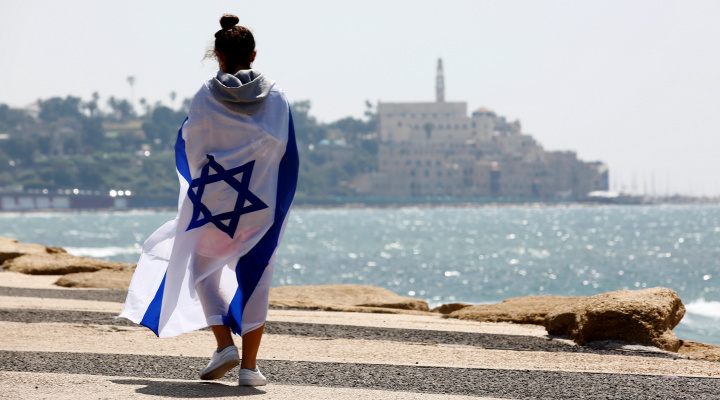
A girl wears an Israeli flag at the shore of the Mediterranean Sea on Israel’s Independence Day marking the 73rd anniversary of the creation of the state, at a beach in Tel Aviv, Israel, April 15, 2021. Photo: REUTERS/Corinna Kern
An analysis released this week predicts that, within the next 10 years, Israel could become the home for a majority of the world’s Jews, a change which, according to the new report, will “redefine the meaning of Jewish peoplehood.”
On Wednesday, the Institute for Jewish Policy Research (JPR) published “The Jewish People in 2126: Demography, Identity, and the Future of a Global Minority,” a 22-page paper by Sergio DellaPergola, a professor emeritus and former chairman of Hebrew University’s Avraham Harman Institute of Contemporary Jewry who now serves as the London-based think tank’s president for its European Jewish Demography Unit.
“In 2026, Jews in Israel represented approximately 46 percent of the world’s Jewish population,” DellaPergola writes in the report. “At current rates of differential demographic growth, the emblematic 50 percent could be surpassed as early as 2035.”
DellaPergola explains that “if a majority of the world’s Jews lived in Israel, tradition dictates that the laws of shemitah, the seven-year rest of the land, would no longer apply in their current form. In any case, this would represent an epochal structural and conceptual transformation of the very essence of being a Jewish People.”
According to Rabbi Y. Dov Krakowski writing for the Orthodox Union’s kosher certification service, “during shemitah, it is biblically prohibited for a Jew to sow, plant, or prune the produce of the land as well as to harvest it. The rabbis went a step further and forbade any working of the land as well (such as fertilizing, et cetera).”
Were the modern-day state of Israel to begin operating according to shemitah, agriculture would shut down every seven years, presumably requiring subsidies to Israeli farmers and for the population to endure higher food prices. Such a law could also transform Israeli real estate and other sectors of the Jewish state’s economy.
The report notes that the Jewish population still has not recovered from the Holocaust. Before World War II, Jews numbered 16.5 million. In 2025 the population reached an estimated 15.8 million.
DellaPergola explains that as the Jewish population continues to rise, its demographics will see fundamental shifts in both location and the level of religious observance.
“Trends in recent years indicate a clear divergence between Diaspora Jews, well below generational replacement rates – like all Western societies – and the Jewish population in Israel, which still enjoys higher fertility rates than any other developed country,” DellaPergola writes. “Even in the secular and nonconformist city of Tel Aviv, an average of two children are born per family, more than in any European country.”
DellaPergola describes how “part – but note, only part – of this highly resilient familial tendency is explained by the gap between religious Jews, particularly Haredim (strictly Orthodox Jews), and secular Jews. Currently, the gap is an average of 6-7 children compared to just over 2, respectively. If we project these differences over several decades, the emerging effect is a profound transformation in the Jewish population structure, primarily in Israel but also in the United States and other countries.”
One of the intriguing trends DellaPergola identifies is a growing interest in Judaism among “numerous groups of believers, especially in Latin America, but also in Africa and Asia, who claim ancient Jewish ancestral origins. Part of this phenomenon is linked to the hypothesis that they are descendants of Jews forcibly converted to Christianity during the Inquisition.”
According to the Jewish Heritage Alliance, today there is “a large Crypto Jewish presence throughout the Western Hemisphere. No one knows for sure how many there really are; however, in Brazil alone an estimated 10 to 25 percent of the total population are Crypto Jews, which translates to 15 to 40 million people.”
DellaPergola also identifies how “others of these new communities have different origins and memories, such as the Lemba, from the southern part of the African continent, who are shown to be genetically descended from the primary group of the Cohanim – the ancient Jewish Priests.”
DellaPergola estimates that “these real or self-imagined crypto-Jewish populations, or dispersed tribes, would put the possible number at around 60-80 million people globally.”
Last year, the Israeli government approved a plan to bring to Israel 1,200 members of India’s Bnei Menashe community by the end of 2026, with the goal of relocating the remaining 4,600 by 2030. Over the past 20 years, approximately 4,000 have already made aliyah, the process of Jewish immigration to Israel.
The Indian group identifies its origins with the biblical tribe of Manasseh, one of the tribes originating with the biblical patriarch Joseph. The group primarily practiced Christianity before converting to Judaism and gaining the recognition of Israel’s Chief Rabbinate. In 2005, the then-Sephardi Chief Rabbi Shlomo Amar recognized the Bnei Menashe as lost tribes.
In the report’s introduction, JPR executive director Jonathan Boyd praises DellaPergola’s track record in analyzing Jewish demography.
“DellaPergola has established himself as the pre-eminent authority on Jewish demography worldwide, combining rigorous empirical analysis with a rare capacity to situate population trends within their broader historical, social and political contexts,” Boyd writes. “His work has shaped academic debate and informed communal and policy thinking across the Jewish world.”
Boyd cautions against believing strongly in predictions of the future.
“Looking ahead to 2126 is not then an exercise in prediction so much as an exercise in perspective,” he writes. “It invites us to consider how enduring processes may interact with contingent events, and how choices made today may resonate across generations.”


