

Jerusalem at a Crossroads: Rethinking Dependence on Washington
Error: Contact form not found.

 by Sabine Sterk

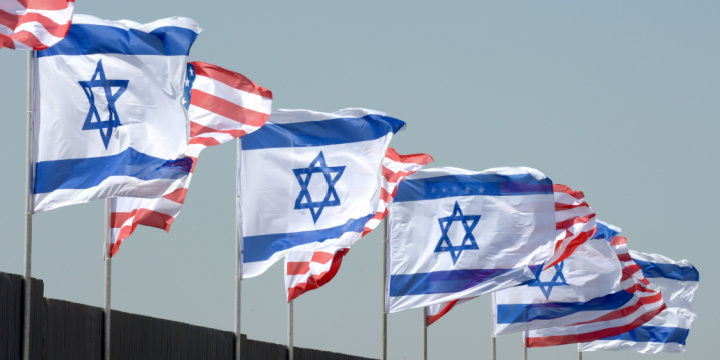
Israeli and American flags displayed at Ben Gurion Airport in March 2013. Photo: Moshe Milner / GPO
There are moments in history when long-held assumptions must be tested against reality. For Israel, that moment may be now.
For decades, the alliance between Jerusalem and Washington has been treated as a cornerstone of Israeli security and Western stability. It has been framed as unshakable, rooted in shared democratic values and mutual strategic interests. Yet the geopolitical landscape of 2026 suggests that this relationship is undergoing a profound transformation, one that demands sober reassessment rather than instant loyalty.
Israel has consistently positioned itself as a frontline state in a volatile region. Its citizens have absorbed the costs of conflict, its military has acted as a stabilizing force, and its leadership has relied on the understanding that its closest ally would stand firmly beside it in moments of existential danger. That assumption is no longer as certain as it once appeared.
American foreign policy has increasingly taken on a transactional character. Strategic partnerships are evaluated through the lens of immediate gain, domestic political calculation, and personal legacy.
Geography matters. The United States operates from a position of relative isolation, buffered by oceans and distance. Israel does not have that luxury. The proximity of Iran and its network of proxies places Israeli civilians within direct range of escalation at any moment. What may be a diplomatic maneuver in Washington is, in Jerusalem, a question of survival.
Recent developments have underscored a troubling imbalance within the alliance. Public statements and private pressures have conveyed the expectation that Israel align itself fully with American timelines and diplomatic initiatives, even when these run counter to its own security assessments. The implication is clear: support may be conditional, and independence may carry a cost.
This is not merely a bilateral issue. It reflects a broader shift in how the United States engages with its allies. From Europe to the Middle East, longstanding partnerships are being tested by demands, ultimatums, and a redefinition of mutual obligations. Institutions that once symbolized collective security are increasingly treated as negotiable instruments rather than enduring commitments.
For Israel, the implications are significant. A strategy built on the assumption of unwavering American backing may no longer be sufficient in a world that is rapidly becoming more multipolar and less predictable. Strategic flexibility is no longer optional. It is essential.
This does not mean abandoning the alliance with the United States. It means recalibrating expectations and preparing for a reality in which Israeli interests must be defended with greater independence. It means diversifying diplomatic channels, strengthening regional and global relationships, and ensuring that critical security decisions remain firmly in Israeli hands.
Engaging with other global actors, even those outside the traditional Western framework, may become part of that recalibration. Such engagement should be approached pragmatically, without illusions, and always with Israel’s security as the guiding principle.
Alliances endure when they are grounded in mutual respect and aligned interests. When those foundations begin to shift, responsible leadership requires adaptation rather than denial.
Israel has always demonstrated resilience in the face of uncertainty. The challenge now is not only to confront external threats, but to navigate a changing international environment with clarity and resolve.
At stake is not the end of a partnership, but the recognition that Israel’s future cannot depend on assumptions formed in a different era. The responsibility for its security, as always, ultimately rests in Jerusalem.
Sabine Sterk is the CEO of Time to Stand up for Israel.