


BDS Eats One of Its Own: Sally Rooney and Her ‘Boycott-Friendly’ Hebrew Translation
Error: Contact form not found.

 by Chaim Lax

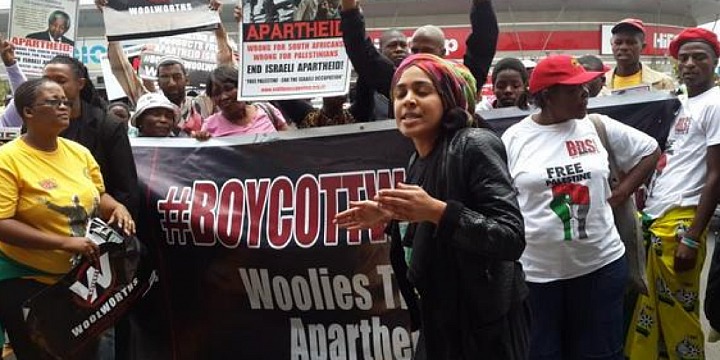
Supporters of the BDS movement in South Africa. Photo: Twitter screenshot.
It was recently announced that acclaimed Irish novelist Sally Rooney’s newest work, Intermezzo, is due to be translated into Hebrew and released by an Israeli publishing house.
That’s the same Sally Rooney who, in 2021, opposed the Hebrew translation and publication of her third novel by an Israeli company due to her affiliation with the anti-Israel BDS movement.
So what changed?
According to two lengthy editorial pieces, one in +972 Magazine and the other in The Guardian, Rooney’s latest Hebrew translation is being published through an Israeli company deemed “BDS-compliant.”
+972 Magazine’s piece is written from an extreme leftist Israeli perspective, while The Guardian’s is presented as a conversation between Rooney and a Palestinian Irish activist. While the two articles come from different places, they ultimately push the same message: that boycotting Israel is a morally justified response to alleged Israeli crimes.
Yet both also attempt to soften the image of the BDS movement by presenting it as selective and principled rather than absolutist.
Under this framework, Israelis themselves are not necessarily beyond the pale, provided they meet certain ideological conditions.
Rooney’s new Israeli publisher, November Books, reportedly qualifies because it supports the Palestinian “right of return,” does not operate beyond the Green Line, and does not receive Israeli government funding.
But this attempt to market BDS as a humanitarian campaign rather than a movement fundamentally opposed to Jewish self-determination requires a considerable degree of intellectual dishonesty.
Both pieces ignore the many public statements by leading BDS figures openly declaring that the movement’s ultimate aim is not coexistence alongside Israel, but the dismantling of the Jewish State itself.
And that contradiction was immediately exposed by the furious backlash Rooney received from within the anti-Israel activist ecosystem itself.
Despite efforts by Rooney and +972 Magazine to portray this as an ethically acceptable compromise, many activists saw any Hebrew publication deal, even with a “boycott-compliant” Israeli publisher, as a betrayal.
Susan Abulhawa, whose online presence often veers into antisemitic rhetoric, was indignant at the notion that any Israeli company could be considered genuinely “independent” and accused +972 Magazine of acting as a false ally to Palestinians.
Meanwhile, Mohammed El-Kurd condemned the +972 Magazine article for “creating loopholes to bypass sanctions,” making clear that for many activists, there is no such thing as an acceptable Israeli partnership.
The broader online reaction was even more revealing:
- One activist described Rooney’s decision as a “disgusting, insulting betrayal.”
- An account by the name “Trans Judeo-Bolshevik” questioned whether Rooney’s choice to publish in Israel (even if it’s a “BDS-friendly” publishing house) is “ethical” and called the Irish author out for potentially alienating her fans.
- One post received almost 75,000 views accusing Rooney of hypocrisy “while desperately having a burning desire for books to be published in Israel through a BDS loophole.”
- Another user declared that “modern Hebrew is the language of Fascism” and that Rooney could not “redeem it.”
The episode ultimately reveals something important about the nature of the BDS movement.
No matter how carefully some activists attempt to rebrand BDS as a limited human rights campaign, the movement’s own grassroots supporters repeatedly expose its underlying absolutism. The backlash against Rooney demonstrated that many within the movement are not interested in dialogue with “good Israelis,” ideological litmus tests, or selective engagement. For them, any normalization of Israel, even through a politically aligned Hebrew-language publisher, is unacceptable.
Much like the proverbial pig who cannot be beautified with lipstick, the BDS movement cannot be turned into something palatable to Israelis or fair-minded people.
That is because the movement is not fundamentally about criticizing Israeli policy. It is about rejecting Israel’s legitimacy altogether. And any attempt to present BDS as something more moderate, nuanced, or coexistence-oriented inevitably collapses under the weight of its own supporters’ rhetoric.
The author is a contributor to HonestReporting, a Jerusalem-based media watchdog with a focus on antisemitism and anti-Israel bias — where a version of this article first appeared.


