



The Myth of Collective Punishment in Lebanon
Error: Contact form not found.

 by Joel M. Margolis

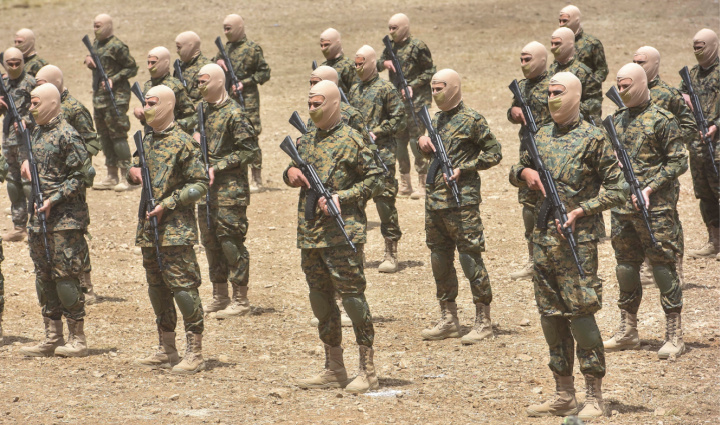
Lebanese Hezbollah fighters take part in cross-border raids, part of a large-scale military exercise, in Aaramta bordering Israel on May 21, 2023, ahead of the anniversary of Israel’s withdrawal from southern Lebanon in 2000. Photo: Fadel Itani/NurPhoto via Reuters Connect
Some Middle East observers are so eager to defame Israel that they misapply international law.
The Lebanon-based terrorist organization Hezbollah launched its latest war on Israel on October 8, 2023 — one day after Hamas’s October 7 invasion of Israel. To defend against the attack, Israel sent war planes and ground troops into Lebanon.
In March 2026, after two and a half years of inconclusive skirmishes, the Israel Defense Forces (IDF) intensified its ground operation. The IDF ordered the evacuation of more than a million Lebanese civilians from a certain “security zone” in southern Lebanon, and bulldozed local Hezbollah outposts, including some that were embedded in homes, schools, and hospitals.
Various public figures condemned the enlarged IDF campaign in southern Lebanon as a “collective punishment” under international humanitarian law, otherwise known as “IHL.”
Among those who hurled the IHL accusation were the United Nations Human Rights Commissioner, the government of Turkey, the human rights organization Amnesty International, the French news network France 24, and many more.
In reality, the IDF mission bears no resemblance to collective punishment.
Collective punishment is “a form of sanction [e.g. judicial penalty or physical assault] imposed on … a group of persons in response to a crime committed by … a member of the group.”
The prohibition on collective punishment was adopted in reaction to wartime atrocities where a combatant would punish an entire group of civilians for a crime committed by just a few of them.
A determination of collective punishment requires proof that the party: (a) intended to penalize a group collectively for a given crime; and (b) actually punished the group regardless of who committed the crime.
There was no crime that Israel intended to penalize through collective punishment and no actual punishment.
The IDF evacuation orders in southern Lebanon, along with the related property destruction, fully complied with IHL, which actually requires warring parties to “remove the civilian population … from the vicinity of military objectives.”
The IDF evacuation of civilians from southern Lebanon properly removed them from the Hezbollah-shaped battlefield. The procedure probably saved many Lebanese lives. Far from violating IHL, the evacuation actually upheld IHL.
The evacuation also promoted IHL by foiling two Hezbollah war crimes. One of the Iranian-backed militia’s war crimes consisted of fighting among Lebanese civilians to shield its operatives from attack.
When the cowardly ploy drove the “human shields” to their deaths, the group’s IHL liability expanded. Fortunately, because the endangered villagers fled the zone of combat, they could no longer be placed in the line of fire.
The other Hezbollah war crime was the targeting of Israeli civilians.
From the start of its aggression, the extremist group bombarded northern Israeli communities with rockets, missiles and drones, killing area residents. The IDF disrupted that barbarous tactic through the evacuation and occupation of southern Lebanon. Hezbollah militant airstrikes still terrorize Israel’s border towns. But the IDF strategy is expected gradually to protect the Israeli populace.
Lebanese civilians were not the only ones evacuated during the war. The IDF also pulled tens of thousands of Israeli civilians from communities near its Lebanese border. No one could seriously call the latter migration an Israeli collective punishment of its own people. The goal of both initiatives was to save lives.
The IDF demolition of Lebanese property also followed IHL. Generally speaking, a “civilian object” such as a home, school, or hospital is legally immune from military attack. However, if a civilian structure is commandeered for military use, it may lose its IHL protection and become a “military object” lawfully subject to attack. This restriction is a corollary of the rule that prohibits soldiers from fighting among civilians.
Throughout southern Lebanon, Hezbollah illegally hijacked civilian sites — including homes, schools, hospitals, and even ambulances — for military purposes. The terrorists exploited the facilities to store weapons, build command posts, dig attack tunnels, and plant rocket launching positions. Once the civilian objects were converted to military objects, the IDF validly destroyed them in the course of dismantling Hezbollah’s terrorist infrastructure.
The IDF demolition effort in southern Lebanon was widely misreported. One eye-witness called it a “scorched earth policy,” as if the crumbled homes, schools and hospitals deserved civilian protection. But Hezbollah’s illegal misuse of the buildings stripped them of their IHL halos.
Recent opinion polls in Lebanon found that 86% of the public never wanted Hezbollah to drag their country into a war with Israel, and 58% said the radicals should be disarmed.
The Lebanese people are exasperated from paying the price – in terms of lost lives and property — each time that their resident terrorist group stages another anti-Israel upheaval. Apparently, the real culprit behind the “punishment” of the population is not Israel. It’s Hezbollah.
Joel M. Margolis is the legal commentator of the American Association of Jewish Lawyers and Jurists, the US Affiliate of the International Association of Jewish Lawyers and Jurists. He is the author of The Israeli-Palestinian Legal War.


