


The Gaza Flotilla Was Never About Aid
Error: Contact form not found.

 by Justin Amler

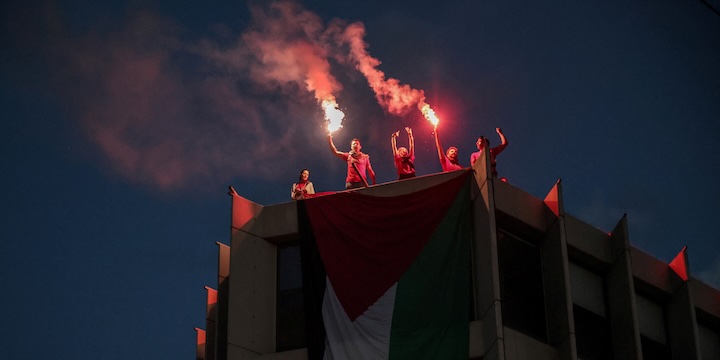
Protesters who hung a huge Palestinian flag at a building facing the Israeli embassy, lit flares during a protest over the interception of the Gaza aid flotilla, in Athens, Greece, May 21, 2026. Photo: REUTERS/Louisa Gouliamaki
The Global Sumud Flotilla was never about humanitarian aid.
It was about spectacle.
The activists aboard did not bring any meaningful assistance to Palestinians in Gaza. They brought cameras, slogans, livestreams, and a carefully constructed political narrative designed to provoke confrontation with Israel and then market themselves to the world as victims of oppression.
This was not humanitarianism. It was performance activism staged on international waters — a well-rehearsed show we’ve seen many times before.
Because like so much activism surrounding Israel, the script had already been written long before the flotilla had even set sail.
So when Israeli forces inevitably boarded the vessels, participants and supporters immediately began describing themselves as having been “kidnapped,” “abducted,” or “held hostage” by Israel.
But words matter.
And using such language in the aftermath of October 7 — when Israeli men, women, and children were dragged into Gaza, tortured, starved and held underground for months — is not merely inaccurate. It is morally grotesque.
Because temporary detention and deportation during enforcement of a naval blockade are not remotely comparable to genuine hostage-taking.
Activists being detained after deliberately engineering a confrontation with a sovereign state and innocent civilians being kidnapped by a terrorist organization during a massacre are not just in different worlds — they’re in different universes.
And let’s not forget the reason for the naval blockade in the first place.
It began in January 2009, after years of rocket fire from Gaza and after increasing weapons smuggling to Hamas, following the terror group’s violent takeover of Gaza in 2007. The blockade’s intention was to prevent importation of weapons, explosives, missiles, and other military material to Hamas and other terror groups.
Far from being illegal, its international legitimacy was confirmed in the UN’s 2011 Palmer report, which concluded that Israel faced a genuine security threat and that the naval blockade itself was a “legitimate security measure” under international law.
Israel was and remains completely within its rights to enforce the blockade and prevent those deliberately trying to break it.
None of this appears to trouble many of the flotilla participants, who cast themselves as champions of universal justice while displaying striking selectivity in the causes they choose to champion.
Curiously, that quest for universal justice only extends to Israel, bypassing the treatment of the Uyghurs in China, the mass atrocities taking place in Sudan, or the treatment of women in Afghanistan.
The inability, whether malicious or not, to tell the difference between a terror group and its victims is a hallmark of much of this activism we see today.
And increasingly, modern activism depends upon the deliberate erosion of those distinctions.
Everything becomes “genocide” or “apartheid” — even when they’re not.
Language once reserved for some of humanity’s gravest crimes is now deployed casually for political theatre and social media outrage. It is deliberately used against Israel in a cynical ploy of moral inversion.
Even many of the flotilla’s claims about mistreatment quickly became part of this performance.
That’s not to say Israeli officials are above criticism, and Minister Ben Gvir’s antics against the flotilla detainees were roundly condemned across Israel’s own political echelon, including Prime Minister Netanyahu and Foreign Minister Sa’ar.
Yet allegations of severe abuse and assault were quickly presented publicly as established fact despite strong denials from Israeli authorities. Because at the same time, footage emerged showing detainees smiling, filming themselves, and interacting casually aboard Israeli vessels — imagery which sat uneasily beside some of the more sensational descriptions rapidly circulating online.
Among the 430 flotilla participants from 40 different countries were 11 Australians — all detained and all deported.
It included one who said that the “so-called Australian government is an active participant in the genocide of the Palestinian people.” She also later posted on Instagram that she had been kidnapped.
Activists deliberately sought confrontation with Israeli authorities, then portrayed the entirely predictable consequences of that confrontation as proof of Israeli criminality.
Victimhood itself has become performative currency, and few understand that better than the activists aboard this voyage of victimhood.
The detainees of the Global Sumud Flotilla were not innocent victims caught up in forces beyond their control. They were political activists who deliberately sought confrontation with Israel in order to place it once again on trial before global opinion.
The flotilla was never about delivering aid. It was about delivering a narrative. And for the activists aboard this voyage of victimhood, that mission succeeded just as they intended.
Justin Amler is a policy analyst at the Australia/Israel & Jewish Affairs Council (AIJAC).


