







Why Is Reuters Complying With the Iranian Regime’s Media Censorship?
Error: Contact form not found.

 by Sharon Levy

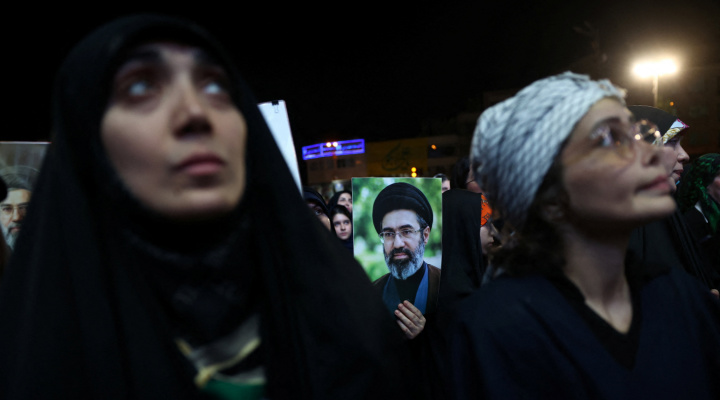
A woman holds an image of Iran’s Supreme Leader Mojtaba Khamenei, during a rally in Tehran, Iran, June 1, 2026. Photo: Majid Asgaripour/WANA (West Asia News Agency) via REUTERS
Shortly after the 1979 Iranian Revolution, the Islamic Republic imposed sweeping restrictions on press freedom.
Although Iran’s constitution nominally guarantees freedom of the press, it includes a broad caveat prohibiting content deemed harmful to the “fundamental principles of Islam” or public rights, a provision the regime has repeatedly used to suppress independent journalism.
The result is a media landscape tightly controlled by the state, with Iran consistently ranking near the bottom of the World Press Freedom Index.
Last week, those restrictions took on even greater significance.
Iran’s Foreign Media Department has issued new regulations requiring international outlets to state that there is “no access” to Israeli media in any material sourced from Iranian organizations. The directive effectively bars Israeli journalists and media outlets from legally republishing such material and threatens foreign organizations with repercussions if they fail to comply.
Reuters, along with other foreign outlets, has already begun complying. In an email sent to its Israeli clients, the news agency cited its adherence to “restrictions on content originating from Iran.”
The fact that one of the world’s largest news agencies is implementing this directive demonstrates how Tehran’s censorship demands are shaping the global flow of information far beyond Iran’s borders.
More troubling still is the impact these restrictions will have on reporting from dissident and independent Iranian voices. For years, Persian-language outlets such as BBC Persian, VOA Persian, Iran International, Radio Farda, and Manoto have operated under intense pressure from the regime.
In practice, the new rules prevent international news organizations inside Iran from allowing their reporting, video footage, photography, and other content to be shared with or rebroadcast by some of the most far-reaching independent Persian-language media outlets.
This is yet another attempt by the regime to silence dissident voices and maintain an iron grip over the narratives emerging from inside the country.
The directive comes as internet access has only recently been restored following a record-breaking 88-day shutdown imposed during anti-regime protests earlier this year. Together, these restrictions reflect a broader effort to isolate Iranian citizens from the outside world while tightening state control over what information can reach both domestic and international audiences.
Reuters – and any other foreign outlet that agreed to these terms – could have pushed back.
Why, then, did Reuters choose compliance with a regime that systematically terrorizes its own people while threatening regional and global stability? And if, as Reuters claims, advancing media freedom is a core principle, how can it justify adherence to regulations designed explicitly to undermine that freedom?
By complying, Reuters is acquiescing to a regime that actively restricts access to information in Farsi and is helping shape the flow of information in ways that benefit the authorities at the expense of the Iranian people’s freedom of expression.
The consequences are far from theoretical.
These restrictions will further hinder dissident media outlets, many of which rely on independent journalists and photographers inside Iran whose work is distributed through international agencies such as Reuters. Meanwhile, official regime statements and state-approved narratives continue to circulate unhindered, ensuring that Tehran’s messaging reaches global audiences without meaningful obstruction.
The result is a system in which independent, anti-regime voices face mounting barriers, while billion-dollar international news agencies comply with rules imposed by the very regime those voices seek to challenge.
The author is a contributor to HonestReporting, a Jerusalem-based media watchdog with a focus on antisemitism and anti-Israel bias — where a version of this article first appeared.


