







In Iran, Christians Are Prosecuted as ‘Zionist Traitors’
Error: Contact form not found.

 by Mariam Wahba

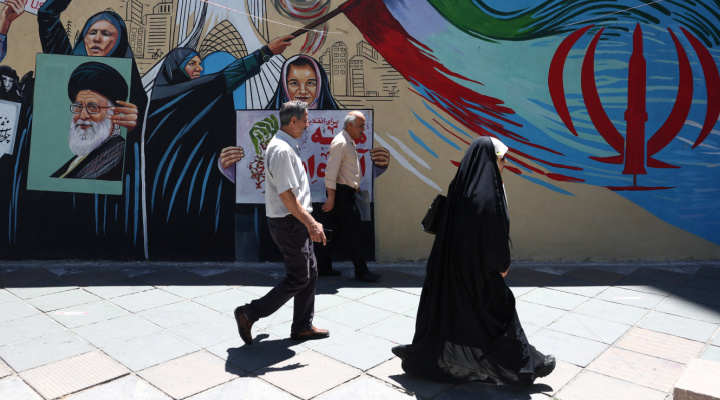
It takes little to be branded a traitor in the eyes of the Islamic Republic of Iran. But since the start of Operation Epic Fury, Iran’s Christian communities have been accused of something worse: being Zionists.
In May, Iranian authorities announced the arrest of three leaders of what they described as a “Christian evangelistic network.” According to state prosecutors, the individuals had established a house church, converted family members and friends, and promoted what regime authorities called “Zionist Christianity.” Officials further accused them of praying for Israel’s victory and acting against the interests of the Islamic Republic.
The accusation is not an aberration. After the 12-Day War in June 2025, the regime stepped up its attacks on Christian communities, accusing church leaders of being “Mossad mercenaries.” An estimated 53 Christians were arrested and charged with “moharebeh,” or enmity against God — an offense that carries a potential death sentence. In 2024, Iran’s imprisonments of Christians surged six-fold compared to 2023.
These instances have cemented a notable evolution in the regime’s approach to its Christian communities. Rather than simply condemning Christians as apostates and traitors, Tehran is persecuting Christians as agents of a foreign enemy.
For Iran’s Christians, these crackdowns are part of an ongoing pattern. Under the regime’s strict interpretation and application of Sharia law, Christians have suffered since 1979.
Churches have been shuttered, house churches raided, and believers imprisoned on vague national security charges.
As the regime has faced military pressure from without and growing dissatisfaction at home, it has become increasingly eager to identify domestic scapegoats. Christians, particularly Persian-speaking converts, provide a convenient target.
Convert communities tend to be independent of state-controlled religious institutions, often connected to underground networks, and represent an alternative to the Islamic ideology on which the regime bases its legitimacy.
The regime’s fear of Christianity extends beyond theology. It views Christians and Christian converts as a serious threat to the revolution. Since 1979, the regime has justified its authority through its claim to govern in the name of Islam. Conversion, therefore, is more than a spiritual decision, but rather a rejection of the ideological foundations of the state itself.
This also helps explain why the regime has reacted aggressively to Christianity’s growth. Despite decades of repression, religious monitors and advocacy organizations have documented the rapid expansion of underground Christian communities. In response, authorities have systematically targeted house churches, shut down Persian-language congregations, and focused particular attention on Muslim converts to Christianity.
Courts have repeatedly prosecuted converts and church leaders on national security charges, while state media increasingly portrays evangelism as a foreign-backed effort to undermine the Islamic Republic.
Despite this, house churches continue to operate, Christian content circulates online despite government surveillance, and converts continue to emerge despite the risk of arrest.
The regime’s decision to merge Christianity with Zionism in the public’s eyes is politically useful. By framing Christian converts as agents of a foreign adversary, Tehran can recast religious repression as national defense.
For decades, the Islamic Republic has sought to cast almost every form of dissent as foreign interference. Student protesters, women’s rights activists, journalists, and political dissidents have all been accused of serving outside powers. Christians are now increasingly finding themselves added to that list.
Yet the persistence of Iran’s underground churches suggests the strategy has failed to stem Christianity’s growth. If anything, the regime’s escalating rhetoric reveals its own insecurity on a front rarely discussed.
In Iran, Christians are no longer simply apostates. They are “Zionists,” foreign agents, and traitors. The regime is reasserting a posture as old as the revolution itself: any challenge to its monopoly on religious authority is a threat to the state itself.
Mariam Wahba is a research analyst at the Foundation for Defense of Democracies. Follow her on X @themariamwahba.