




Vance Pushes for Iran Role in Lebanon Deal as Israel Warns of Growing Strategic Risk
Error: Contact form not found.

 by Ailin Vilches Arguello

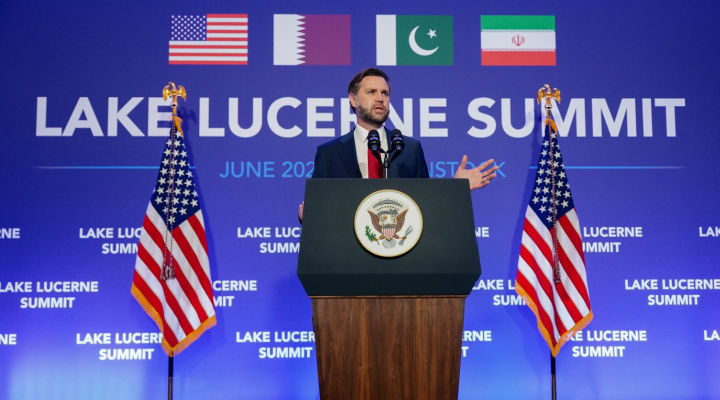
US Vice President JD Vance speaks to members of the media before boarding Air Force Two, after the US and Iran held high-level talks at the Lake Lucerne Summit, at Emmen Military Air Base, Emmen, Switzerland, June 22, 2026. Photo: REUTERS/Nathan Howard/Pool
US Vice President JD Vance is pushing a controversial diplomatic strategy that would bring Iran into talks on Lebanon in an effort to pressure Hezbollah to comply with ceasefire obligations — a move that has sparked alarm in Israel over Tehran’s growing influence in the country’s security landscape.
Earlier this week, Samir Geagea, leader of Lebanon’s largest Christian party, sent a letter to Vance urging a change in course on a new emerging agreement, after reports surfaced of a US-backed diplomatic initiative involving Iran to establish a “deconfliction mechanism” for the country.
“Ending the military and security presence of Hezbollah constitutes, in our view, the greatest contribution that can be made to the Christians of Lebanon and to all Lebanese people, as it opens the door to building the state we all aspire to: an effective, sovereign state that is free, strong, and capable of ensuring security, stability, and prosperity for all its citizens,” Geagea wrote in a statement.
In response, Vance defended once again the recently signed and increasingly contentious US–Iran memorandum of understanding and the newly introduced initiative, insisting that Washington is working to strengthen Lebanon’s sovereignty and institutional control.
“The United States recognizes the President of Lebanon, General Joseph Aoun, and the Lebanese government as the only legitimate authority in the country. Washington intends to work with the Lebanese state to enable it to protect its sovereignty and establish its legal authority,” the US official wrote in a statement.
“The talks the US administration is conducting with Iran regarding Lebanon are not meant to grant Tehran any role in determining Lebanon’s future or influencing its decisions, but to ensure that Iran exerts pressure on Hezbollah to fulfill the commitments and obligations imposed on it,” Vance continued.
However, Iran has long provided political, financial, and military backing to the Lebanese terrorist group while seeking to expand its influence in the country. According to the US Treasury Department, Iran continued financing Hezbollah despite years of sweeping US sanctions, transferring roughly $1 billion to the group during the first 10 months of 2025.
Both Iran and Hezbollah openly seek Israel’s destruction.
According to a report by the Saudi news outlet Al Arabiya, the Iranian regime is believed to have officers operating in the Ali Taher Ridge area in southern Lebanon, where they reportedly play key roles in directing Hezbollah’s combat operations and coordinating the terror group’s activity.
Unveiled on Monday after the first high-level US-Iran talks in Switzerland, officials announced the new US-backed diplomatic initiative involving the Iranian regime that would establish a “deconfliction mechanism” for Lebanon, from which Israel was notably excluded.
Under this framework, the United States would be joined by Iran, Qatar, and Pakistan in a coordination system designed to manage tensions in Lebanon and reduce the risk of escalation between Israel and Hezbollah.
Israeli officials have publicly opposed the initiative, warning it could erode Israel’s freedom of military action while effectively elevating Tehran’s role in Lebanon’s security architecture and political balance.
According to multiple media reports, some versions of the proposal suggest it could restrict Israeli military activity in Lebanon to responses against “imminent threats,” potentially limiting broader preemptive strikes against Hezbollah terrorist infrastructure.
Amid mounting speculation over a potential Israeli withdrawal from Lebanon, Israeli Prime Minister Benjamin Netanyahu issued a firm statement reaffirming the Israel Defense Forces’ authority to operate freely to protect the country’s northern border.
“My directive, and that of the Minister of Defense, to the IDF is clear and has not changed: Our fighters in southern Lebanon have full freedom of action to thwart any direct or developing threat to them or to the residents of the north,” the Israeli leader said. “The IDF has no restrictions on this matter. I stand behind them; the entire nation stands behind them.”
“My stance is firm on our remaining in the security zone in southern Lebanon for as long as is required in order to protect the residents of the north and all citizens of the state,” Netanyahu continued.
Experts argue that the proposed mechanism would effectively formalize Iran’s regional leverage by granting it a seat in coordination efforts while excluding Israel from decisions directly affecting its security environment, warning that it risks entrenching Iranian influence in Lebanon as Hezbollah remains heavily armed along Israel’s northern border.
The Trump administration has intensified criticism of Israel’s military campaigns in recent days, publicly claiming that the Jewish state incurs far too much collateral damage when targeting terrorists in Lebanon.
“You don’t have to knock down a building every time somebody walks into it that’s from Hezbollah,” US President Donald Trump said during a press conference last week.
Meanwhile, Lebanon and Israel began a new round of talks on Tuesday in Washington, with Beirut determined to press ahead with direct negotiations even as they appear increasingly overshadowed by Iran’s decision to make Lebanon part of its talks with the US.
Lebanese officials have insisted that face-to-face negotiations with Israel are the only way to secure an end to the war raging since March 2, when Hezbollah fired at Israel in support of Tehran and triggered Israeli air and ground attacks.
Lebanon has said that one of its key objectives in the talks is securing an Israeli military withdrawal, while Israel views the negotiations as a pathway toward Hezbollah’s disarmament and a broader security agreement.
Hezbollah has repeatedly rejected disarming in full and has called on the Lebanese government to withdraw from its direct talks with Israel.