






The New Lebanon Deal Is a Seismic Shift — But Not How You Think
Error: Contact form not found.

 by Daniel Pomerantz

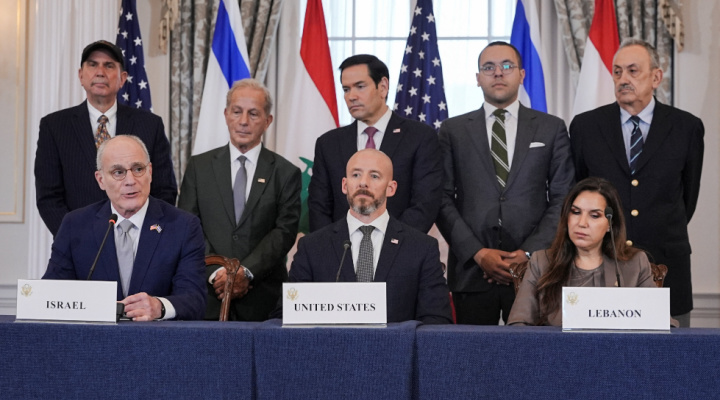
Israel’s Ambassador to the US Yechiel Leiter speaks next to US Secretary of State Marco Rubio, State Department Counselor Daniel Holler, and Lebanon’s Ambassador to the US Nada Hamadeh during a meeting at the State Department in Washington, DC, US, June 26, 2026. Photo: REUTERS/Ken Cedeno
The “Trilateral Framework” agreement, between Israel, Lebanon and the United States, signed on June 26, 2026, is utterly groundbreaking, and also entirely meaningless, all at the same time.
Here’s what you need to know.
Some parts of the Framework are a very big deal, even more than most people realize — and there are three parts that really matter.
First: An upheaval of historic proportions lies “hidden in plain sight,” right at the beginning of the document:
Israel and Lebanon affirm the right of each state to exist in peace, and their mutual desire to live in security as neighboring sovereign states.
In other words: Lebanon has, for the first time in history, acknowledged Israel’s existence and right to continue existing.
This is a seismic shift, which the world hardly even noticed.
Pressure from Hezbollah, Iran, Palestinian groups, and a long tradition in the Arab world all simply fell by the wayside in this one, world-changing sentence.
Second: Another dramatic subtlety is what isn’t mentioned in the document: Iran. The Islamic Republic is not even mentioned once. By contrast, a core feature of the framework is disarming and dismantling Hezbollah, and as a result, Iran’s local influence.
Despite Iran’s insistence on incorporating Lebanon and Hezbollah into its MOU with the United States, the Islamic Republic has instead become diplomatically weak, and even worse (from the regime’s point of view), irrelevant.
That in itself is a small victory.
Third: The IDF will stay inside Lebanon and will continue defending Israel as long as needed.
The document, cleverly, doesn’t say this outright. Instead, the Framework sets out an intricate system for Israel’s withdrawal, including various regions and “pilot” projects, specific benchmarks, and even a small initial pullback from minor areas.
Yet the essence of the Framework is powerfully simple: IDF withdrawal is tied to disarming and dismantling Hezbollah — whether that process takes a day or an eternity.
In other words, Israel now has explicit support from the United States and the State of Lebanon to stay inside Lebanon and to militarily defend Israel for as long as necessary. This directly contradicts the Iranian understanding of the MOU, which (Iran claims) calls for a full and immediate Israeli withdrawal from Lebanon (it does not).
Many initially viewed the MOU as a kind of inexplicable American capitulation to the Islamic regime, and with good reason. Among other problems, Iran’s interpretation of the MOU would re-empower Hezbollah and place Israel’s northern residents in unacceptable danger.
Indeed, in recent weeks, US President Donald Trump placed significant pressure on Israel to tolerate attacks by Iran and Hezbollah, including dramatic outbursts such as telling Israeli Prime Minister Benjamin Netanyahu, “You’re f***ing crazy.”
Yet this Framework demonstrates that the White House actually has its own ideas on how to interpret and implement the MOU, despite Iranian objections. If Iranian influence in Lebanon is off the table despite the MOU, what other changes lie in store?
Why the Framework actually doesn’t matter at all:
The essence of the Framework is Israeli withdrawal in exchange for the official Lebanese government disarming and dismantling Hezbollah, and re-asserting sovereignty over its own country.
This is a lofty goal, and a worthy vision for both the Israeli and Lebanese people. Yet as we’ve explained in detail, it’s presently impossible for one simple reason: Hezbollah controls Lebanon.
In addition to having military capacity that rivals the Lebanese Armed Forces (the “LAF”), Hezbollah also holds the largest voting bloc in the Lebanese parliament. Indeed, the Framework was signed by Lebanon’s ambassador to the United States, but never actually adopted by Parliament – that’s politically impossible.
Now the very same Lebanese government that is controlled by Hezbollah must somehow disarm Hezbollah, under the terms of a Framework that it never officially adopted.
It’s like asking Hezbollah to disarm itself.
Indeed, this is the fourth time in under 25 years that Lebanon has “agreed” to disarm Hezbollah, and yet — here we are, agreeing once again to do what we’ve (supposedly) already agreed to three times.
But there’s still hope.
The Framework makes reference to assistance by “international and, particularly Arab partners, under the leadership of the United States.” It seems unlikely that any power outside of the IDF will be willing to fight head to head against Hezbollah, but with adequate military support, and by completely sidelining the Lebanese Parliament (in violation of Lebanon’s Constitution), there is some small chance the Framework could actually be implemented.
The more likely outcome is that Hezbollah remains armed and active at least until the eventual collapse of its main sponsor, the Islamic Republic of Iran. Until that time, the IDF will stay in place, but now with explicit American and Lebanese support.
Daniel Pomerantz is the CEO of RealityCheck, an organization dedicated to deepening public conversation through robust research studies and public speaking.


