




Ahead of the 2028 Presidential Election, Competing Worldviews on Iran Will Be on Full Display
Error: Contact form not found.

 by Steve Wenick

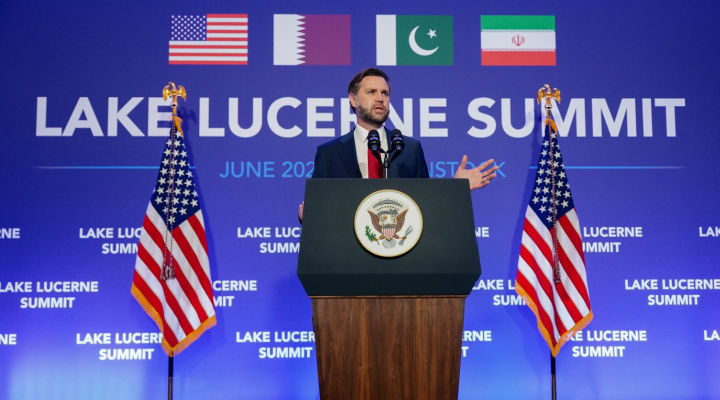
US Vice President JD Vance speaks to members of the media before boarding Air Force Two, after the US and Iran held high-level talks at the Lake Lucerne Summit, at Emmen Military Air Base, Emmen, Switzerland, June 22, 2026. Photo: REUTERS/Nathan Howard/Pool
As Republicans look toward the 2028 presidential election, the most important contest may not be between Vice President J.D. Vance and Secretary of State Marco Rubio, but between two fundamentally different visions for confronting the world’s leading state sponsor of terrorism.
Both men agree that Iran must never be allowed to acquire nuclear weapons. Their disagreement is over how that objective is best achieved. Rubio understands that lasting peace begins with deterring aggression, confronting Iran’s terrorist empire, and standing unequivocally with Israel, America’s strongest and most dependable ally in the Middle East. Vance, by contrast, appears to believe that restraining Israel and accommodating Tehran can produce stability. History suggests exactly the opposite.
The contrast between Rubio and Vance has become increasingly difficult to ignore. Vance has repeatedly suggested that Israel’s military campaign against Hezbollah in Lebanon complicated negotiations with Tehran, as though Israel’s first obligation were to protect an American diplomatic initiative rather than defend its own citizens from an Iranian proxy army. Rubio, by contrast, has consistently recognized that Hezbollah is not merely a Lebanese militia but an integral part of Iran’s regional terror network. His approach reflects a clear understanding that weakening Iran’s proxies strengthens America’s strategic position.
The divide became even clearer when Vance negotiated a memorandum of understanding with Iran that accommodated Tehran’s demand for a ceasefire in Lebanon, while Rubio pursued a separate diplomatic track with Jerusalem and Beirut specifically designed to reduce Iran’s influence. One approach treated Iran as a negotiating partner whose demands deserved accommodation. The other recognized Iran as the principal source of the conflict.
The White House insists there is no disagreement. The State Department maintains that the administration is united behind the goal of preventing Iran from acquiring a nuclear weapon. That may well be true. Shared objectives, however, do not erase fundamentally different strategies.
According to administration officials, Rubio was sufficiently skeptical of negotiations with Tehran that he declined to lead the first round of talks. Vance eagerly assumed that role and later headed additional negotiations in Switzerland. The resulting ceasefire has proved predictably fragile, repeatedly threatened by renewed exchanges of fire. That should surprise no one. For more than four decades, the Islamic Republic has treated negotiations not as a path to peace but as a tactical pause that allows it to regroup, rearm, and advance its long-term objectives.
Vance and Rubio publicly dismiss suggestions of rivalry, and there may be none on a personal level. Their foreign-policy philosophies, however, are unmistakably different. Rubio views Iran as a revolutionary regime that exports terrorism, destabilizes the region, and can be contained only through strength, sustained pressure, and unwavering support for America’s allies. Vance appears more willing to subordinate Israel’s and the Arab world’s security needs in the hopes that talks with Tehran can produce a durable settlement.
History offers little support for that hope. The Islamic Republic has repeatedly demonstrated that it interprets concessions as weakness and diplomacy as an opportunity to stall. Every time that Israel strikes Hezbollah, Hamas, or other Iranian proxies, it is not sabotaging peace; it is degrading the terrorist infrastructure Iran relies upon to threaten Israel, intimidate its Arab neighbors, and challenge American interests throughout the region and the world.
If these reports about what’s happening in the Trump administration are accurate, Rubio’s approach is the more realistic — and the more historically informed. Peace will not be achieved by asking Israel to fight with one hand tied behind its back while Iran negotiates with the other. It will come only when Tehran’s leaders conclude that the costs of sponsoring terror outweigh the benefits. Israel understands that. Rubio understands it. Whether Vance does remains questionable.
Steve Wenick is a freelance book reviewer for HarperCollins Publishing and Simon & Schuster. His articles, reviews, and letters have appeared in The New York Times, The Times of Israel, The Jerusalem Post, The Jewish Voice of Southern New Jersey, and the Philadelphia Inquirer.