




The MOU with Iran Is ‘Over’ — Are We Returning to War?
Error: Contact form not found.

 by Daniel Pomerantz

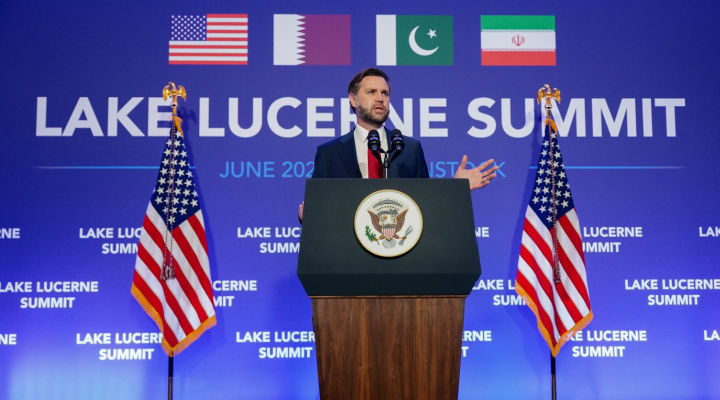
US Vice President JD Vance speaks to members of the media before boarding Air Force Two, after the US and Iran held high-level talks at the Lake Lucerne Summit, at Emmen Military Air Base, Emmen, Switzerland, June 22, 2026. Photo: REUTERS/Nathan Howard/Pool
US President Donald Trump announced this week that the infamous MOU with Iran is “over” and that “Iran is run by sick people.”
What that really means and what happens next is not at all obvious. Here’s what you need to know.

There is something particularly significant in Trump’s phrasing:
Reporter: “Is the ceasefire over? Is the ceasefire done? Is the MOU dead?”
President Trump: “It’s a very interesting question. To me, I think it’s over. I don’t want to deal with them anymore. They’re scum. You know what scum is? They’re scum. They’re sick people. They’re led by sick people and they’re vicious, violent people. And if they had a nuclear weapon, they’d use it. As far as I’m concerned, it’s over.”
The President went on to articulate a critical point that Israelis (and Persians) have known for years, yet has long befuddled Western understanding:
“They’re liars. If I make a deal with them, we have a deal. And he [the Iranian negotiator] goes out, he talks. We make a deal, everyone’s agreed: no nuclear weapon. We make a deal, they [the Iranian delegation] go outside, talk to the press, and they say, ‘We never even talked about it.’ There’s something wrong with them. They’re cuckoo. As far as I’m concerned, it’s over.”
Indeed, this is exactly how Iranians negotiate, as we explored in our article, “How the Iran negotiations actually work” a worthwhile read if you haven’t already seen it. In short, Iran’s negotiators delay and delay, and at the last moment, they verbally agree to exactly what the West wants to hear — but then later pretend the conversation never happened at all.
“It’s like déjà vu all over again”
Why doesn’t the West “get” it?
As a young lawyer I worked in the New York commercial real estate world, including a major negotiation that involved Trump himself. I learned a certain ethic in those negotiations, a kind of trust among professionals — of course we rely on written contracts, we don’t trust each other that much. The players can be tough, misleading and even devious. But if two lawyers (or their clients) agree to something verbally, you can be confident that it will be reflected in the written contract. This isn’t about morality – it’s about efficiency. Most of all, you can trust that everyone has the same basic interest in the end: prosperity, at least for themselves.
For a New York real estate developer, Iran’s negotiation style is hard to believe – the way they twist and deny their own words seems senseless to the point of incomprehensible. The idea that anyone would seek a goal other than prosperity (such as, for example, divine apocalypse – including the destruction of their own civilians, economy and infrastructure) is equally unfathomable.
Iran’s regime and all manner of terror groups have long taken advantage of this Western naiveté.
Yet it seems that Trump just might be starting to “wise up.”
In another press conference a reporter asked, “You said Iranian leaders were very rational people, nice people to deal with, strong people, smart people. Today you said they were scum, sick people and being led by sick people. What changed?”
The President answered, “I got to know them.”

Trump emphasized one especially dire hypocrisy, that goes right to the heart of the extremist-Islamist world view:
“They asked for a time out [from military action]. They wanted to go to the funeral of Khamenei. And I said, ‘Give it to them.’ And they started shooting missiles. I mean, it was the craziest thing.”
None of this is surprising to Israelis, who frequently suffer attacks during Muslim holy days, sometimes originating from inside mosques, and even a massive armed assault from inside the famous Al Aqsa Mosque in 2017.
In addition to using deceased Supreme Leader Ayatollah Khamenei’s funeral as an opportunity to call for the death of the U.S. President, including stoning his picture and hanging him in effigy, the Iranian regime also used the (supposedly) sacred event as an opportunity to fire missiles on American bases, effectively desecrating their own national funeral in a way that America (at Iran’s request) had specifically refrained from doing.
Most importantly for the White House, Iran has continuously worked to block the Strait of Hormuz, violating the only terms in the MOU that were meant to be immediately binding, and undermining one of Trump’s key economic priorities.
America may finally be learning what Israel already knows: Islamists use everything as a weapon: agreements, trust, even holy days and religious sites. They weaponize words, truth, civilians, humanitarian aid, and most especially: Western naiveté.
So are we going back to war?
Not at the moment.
Since declaring that the MOU is “over,” the United States has struck at least 170 Iranian military targets so far (80 on the first night and another 90 on the second).
Yet most targets constituted infrastructure the regime had reconstructed during the eight-week pause related to the MOU. In other words, the U.S. strikes do not look like a renewed campaign against the regime, but merely an attempt to return Iran’s military posture to where it was before the MOU. (The fact that Iran was rebuilding its offensive capabilities at all, despite the MOU and despite its impoverished economic state, should serve as a dire warning to the West.)
President Trump’s use of aggressive language to build leverage, followed by a return to negotiations, has become a recurring pattern. His most recent statements may not be any different.
Israel remains on high alert, but there has been no change to the Home Front Command civilian instructions, a key indicator of imminent combat. Meanwhile, the West as a whole (including Washington) appears to remain allergic to anything resembling regime change, decisive victory or a true understanding of the Middle East.
Yet all of that could change in an instant.
Daniel Pomerantz is the CEO of RealityCheck, an organization dedicated to deepening public conversation through robust research studies and public speaking.