





Negotiating with Iran Won’t Change the Regime’s Fundamental Ideology
Error: Contact form not found.

 by Yoram Ettinger

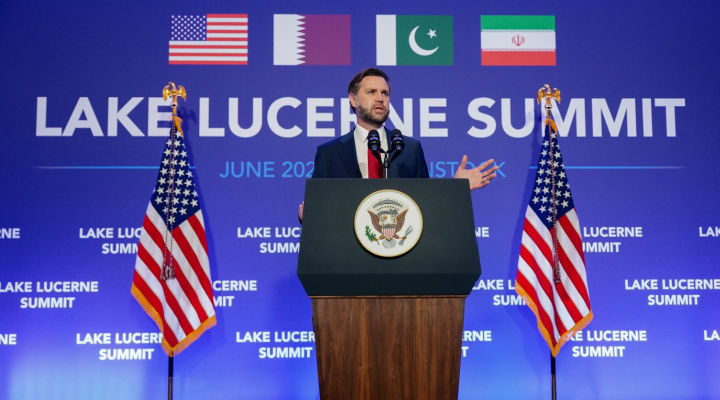
US Vice President JD Vance speaks to members of the media before boarding Air Force Two, after the US and Iran held high-level talks at the Lake Lucerne Summit, at Emmen Military Air Base, Emmen, Switzerland, June 22, 2026. Photo: REUTERS/Nathan Howard/Pool
The 47-year-war launched against the US by the Ayatollah regime, since 1979, predates — and is independent of — any specific US president or policy, as demonstrated during the administrations of Presidents Jimmy Carter, Ronald Reagan, George H.W. Bush, Bill Clinton, George W. Bush, Barack Obama, Joe Biden, and Donald Trump.
The 47-year-track record of the Ayatollah regime — as underscored in its constitution, school curriculum and mosque sermons — provides a body of evidence that the regime’s core belief system highlights anti-Americanism as a foundational pillar of identity, rather than a temporary foreign policy.
The Ayatollah track record mandates the exportation of the Islamic Shiite Revolution (1979 Constitution, article 154), establishing a globally exclusive, “divinely-ordained” Shiite Islamic governance.
The Ayatollah ideology mandates the toppling of the “apostate, treacherous” Sunni regimes, and the West. While the Ayatollah regime frequently displays tactical flexibility, when under extreme pressure, its strategic trajectory demonstrates that ideological objectives transcend financial and diplomatic bonanzas, as well as international norms. For example, in defiance of the mega-billion-dollars of financial pressure/sanctions and temptations, the Ayatollah regime prioritizes the Islamic Revolutionary Guard Corps (IRGC) and its expeditionary arm, the Quds Force, the funding of proxy terror organizations (e.g., Hezbollah, Hamas, Houthis), and the 47-year-strategic entrenchment in Latin America, over providing for the basic needs of its citizens.
The negotiation process provides the Ayatollah regime with the time to relieve pressure, gain tactical concessions, restore and upgrade conventional, ballistic and nuclear capabilities, in cooperation with China, Russia, and North Korea. These countries are eager to prove their reliability and effectiveness as strategic allies, notwithstanding the devastation of their air defenses, combat aircraft, and missile batteries during the 2025 and 2026 Iran wars.
The 47-year-policy of negotiation with the Ayatollah regime has not induced Iranian moderation, but bolstered the anti-US capabilities of the Ayatollah regime. The policy of negotiation has played a key role in catapulting Iran from a second/third rate strategic power to a major global strategic player. In addition, the negotiation policy has played a major role in transforming Iran from “the American Policeman of the Gulf” before the Islamic revolution, to a chief global epicenter of anti-US terrorism, wars, drug trafficking, and money laundering.
The tendency to kick the can down the road has reflected Western policy makers’ inclination to sacrifice medium/long-term national security on the altar of short-term convenience, as has been demonstrated by multiple precedents. Western policy makers view a signed agreement as an achievement, but the Ayatollah regime views a signed agreement as a time stalling tactic, in order to advance its strategic goals.
Approaching the Ayatollah regime as a transactional party overlooks the reality that anti-Americanism is not merely a negotiable policy, or a bargaining chip, but the core identity of the Islamic Republic.
There are no good options in dealing with Iran, but history shows that 47 years of negotiations have not changed the regime’s fundamental ideology at all.
The author is a commentator and former Israeli ambassador.


