

Hamas Wants to Keep Its Arsenal, Just Change the Address
Error: Contact form not found.

 by Uriel Zehavi


A Palestinian man points a weapon in the air after it was announced that Israel and Hamas agreed on the first phase of a Gaza ceasefire, in the central Gaza Strip, Oct. 9. Photo: REUTERS/Mahmoud Issa
Eight foreign ministries asked Washington last week to “ensure and enforce Israel’s full compliance with the commitments and arrangements envisaged under the Comprehensive Plan and its Road Map.” The joint statement went out from Saudi Arabia, Egypt, Jordan, the United Arab Emirates, Qatar, Turkey, Pakistan, and Indonesia.
They merged two documents with that possessive.
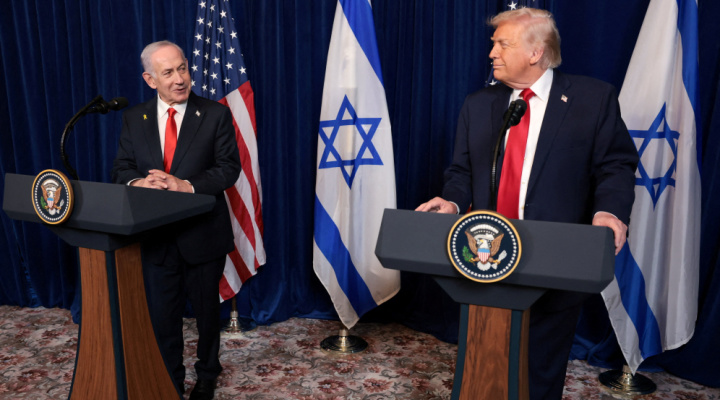
The Comprehensive Plan is President Trump’s 20-point plan of September 2025, endorsed by the UN Security Council in Resolution 2803. Israeli Prime Minister Benjamin Netanyahu accepted it standing beside the US president. The Road Map is a separate 15-point text from the Board of Peace, which Hamas accepted at the end of July. Israel never agreed to that one.
Prime Minister Netanyahu rejected that plan at the cabinet table on Aug. 9 and later did so again.
The eight foreign ministers call that refusal “a direct repudiation of the Comprehensive Plan.” It isn’t. The two texts part company on where Hamas’ weapons will end up.
Point 13 of the Comprehensive Plan is explicit. “All military, terror, and offensive infrastructure, including tunnels and weapon production facilities, will be destroyed and not rebuilt.” The weapons themselves go “permanently beyond use through an agreed process of decommissioning,” under “the supervision of independent monitors.”
Point 8 of the Road Map opens “a process to decommission and store heavy weapons, military production sites, depots of weapons, and tunnels.”
What the Plan destroys, the Road Map warehouses. It names the custodian too — “only NCAG [the National Committee for the Administration of Gaza, a Palestinian body] shall hold, store, or control weapons in Gaza. Point 10 puts the militias’ weapons under the same authority. Then it adds: “No weapons shall be transferred or handed to Israel or non-Palestinian parties.”
But decommissioned and stored is not permanently beyond use.
The Road Map’s first article reaffirms the Comprehensive Plan and Resolution 2803 as the governing framework, and it is drafted as an instrument for implementing that framework. It creates an International Verification Committee to certify what the Palestinian committee does. Washington helped write it.
The ministers’ own statement lists the United States among the mediators who produced it, alongside Egypt, Qatar, and Turkey.
The real objection is narrower, and it survives. Under the Plan, independent monitors verify that a weapon has been put beyond use. Under the Road Map, an international committee certifies that a Palestinian committee is holding it, inside Gaza, with an express bar on handing it to the state those weapons were fired at. Those are two very different endings. And Israel knows better than to accept the lesser outcome here — we have seen, repeatedly, what happens when it does.
Hamas can read. The organization has avoided the word “disarmament” throughout and says instead that it will hand its weapons over to be stored under the Palestinian administration. Israeli officials have called its acceptance a “strategic ambush.”
The Board of Peace appears to have noticed as well. It is reported to be weighing the abandonment of its own phased sequence for a single move: every weapon out of Gaza, then a full Israeli withdrawal. Nothing has been amended yet, and reporting is not a text. But a body rewriting the provision has a hard time calling the objection to it a repudiation.
So, when the statement turns up in your feed, or in a letter asking why Israel obstructs peace, ask which document. The answer is almost always the second one — one that allows Hamas, a jihadist terrorist organization, to effectively retain control over its arsenal.
Eight foreign ministries merged two texts with a possessive because merging them was easier than defending the weaker one on its own.
Uriel Zehavi is Executive Director of the Mitzpe Institute (mitzpe.org) and writes the daily Israel Brief (israelbrief.com). He is the author of four books, most recently Rooted in Judea: Lives and Law in the Heart of Israel, and is making aliyah to Kiryat Shmona with his husband, Modi.