






South African Chief Rabbi Counters Dual Citizenship Proposal, But Not Panicking (VIDEO)
Error: Contact form not found.

 by Maayan Jaffe-Hoffman / JNS.org

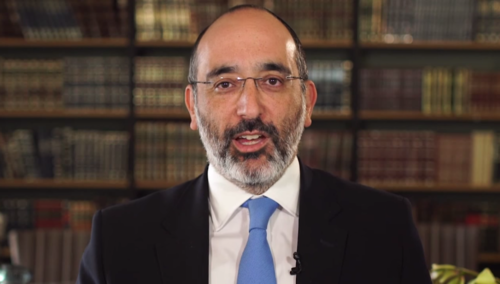
Rabbi Warren Goldstein speaks in a video responding to South Africa’s proposed dual citizenship ban. Photo: Connect with the Chief Rabbi via YouTube.
JNS.org – Anti-Zionists are targeting South Africa, but hold tight and wait to see what happens, South African Chief Rabbi Warren Goldstein tells JNS.org regarding reports of an impending dual citizenship crisis that may affect his country’s Jewish community.
Discussing an early-September call by a deputy cabinet minister and senior official in the ruling African National Congress (ANC) political party that the government should look at changing current laws to ban South Africa’s citizens from holding dual citizenship—which would prevent them from fighting for the Israel Defense Forces—Goldstein says in a phone interview that South African Minister of Home Affairs Malusi Gigaba “called a press conference and said the government is not really considering changing the law…so I think now is not really the time to scream from the rooftop—at least not yet.”
The original statement on dual citizenship, made by South African opposition member Obed Bapela, was met with an uproar by the Jewish community, which felt Bapela was specifically targeting Jews because of his anti-Israel perspective. In particular, Bapela called out those with South African-Israeli citizenship as an example of those who would be targeted by a ban.
Goldstein put out a video refuting Bapela’s statement, and working with the South African Jewish Board of Deputies (SAJBD) and the South African Zionist Federation (SAZF), met with officials to protest the measure.
“The South African Jewish community will not be bullied or intimidated by [Bapela’s] threats,” SAJBD and SAZF said in a joint statement.
Bapela’s policy recommendation to ban dual citizenship was originally discussed in July, was publicly revealed in September, and will be discussed later this month at the ruling party’s national general council meeting.
According to the most recent statistics published by the Jewish Agency for Israel, less than 200 South African Jews make aliyah each year. The proposed measure would not only affect dual Israeli-South African citizens, but also millions of others who reportedly hold dual citizenship, according to a report by the Sunday Times. An article published by the Israeli daily newspaper Haaretz said that there are more than 1,000 South Africans serving as British Marines.
Nevertheless, Goldstein tells JNS.org that the dual citizenship debate is indicative of growing anti-Semitism in South Africa.
“There is a worldwide campaign looking to isolate Israel, and [the] Boycott, Divestment and Sanctions [movement] is well-known for being that campaign,” says Goldstein. “I think they have focused their efforts on South Africa—there is no doubt about that.”
Goldstein says that while some South African government officials are very supportive of Israel, others are brutally antagonistic. In the tussle between the two factions, there is no indication as to who will prevail.
“The accusation is that Israel is an apartheid state—like South Africa was. And that the world should boycott Israel, like it did South Africa. That accusation is completely false. It is a lie,” he says. “But one cannot assume because something is based on lies that it won’t take off. If you repeat a lie often enough, people start to believe it.”
Apartheid in South Africa was a policy or system of segregation or discrimination on the grounds of race. The apartheid laws were instituted in 1948 to ensure the strict segregation of South African society along racial lines and the domination of the Afrikaans-speaking white minority. Apartheid came to a definitive end in 1994, when South African people of all races were able to vote for the first time in a national election. But the system began to slowly dismantle beginning in 1990.
In Israel, Israeli Jews and Israeli Arabs enjoy the same basic freedoms, including freedom of speech and freedom to vote. Goldstein says he uses his newly found freedoms to speak out and refute the lies against Israel, which he feels are “an insult to South Africa’s apartheid.”
Goldstein says Israel is fighting “an existential fight”—yet he is not referring to the Iranian nuclear threat.
“Israel has a brilliant military, but it is losing the war of words,” he says. “That cannot be.”