Dror Karta’s Play With Visual Pun
Error: Contact form not found.

 by Ronen Shnidman / JNS.org

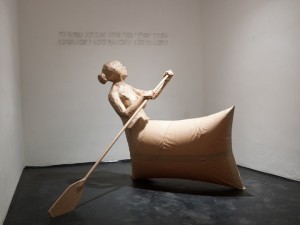
An untitled piece by Dror Karta. Photo: Dror Karta.
Until the advent of surrealist art around the turn of the 20th century, it was rare to see visual artists meaningfully engage with the written word. Call it the divide between visual and verbal learners. But since Rene Magritte’s “This is not a pipe,” artists have been exploring the meaning of words, images and physical objects—and the interplay between them.
Israeli artist Dror Karta, 46, inhabits this world with a relish, combining interpretive pieces with a verbally oriented sense of humor.
Creating mixed media pieces of installation art, Karta’s exhibition this past year at the Tel Aviv art gallery Florentine 45, titled “Warship/Worship,” consisted of 10 pieces made from objects the artist collected over the last decade.
Raised in the coastal city of Netanya in a family of Yemenite Jewish heritage, Karta first set on his artistic path while recuperating from a wound he sustained during an IDF military operation at age 20. While still confined to his hospital room, and looking to pass the time, Karta was inspired by religious tradition and began to create portraits of famous rabbis as well as drawings of the holy city of Safed.
After being released from the hospital, Karta went on to study graphic design for three years in Haifa before opening his first studio, branching out into different modes of artistic expression. For roughly the next 20 years—with the exception of a two-year stint in Holland and Germany—Karta was based in northern Israel, settling with his wife in the artists’ colony of Ein Hod. Karta’s latest “Warship/Worship” exhibition marked the move of his studio from Ein Hod to Tel Aviv, which allowed the artist to be closer to the epicenter of Israeli culture.
“I moved [the studio] from the North to Tel Aviv, because up North everything is simply dead from the perspective of art and culture,” Karta said during a recent interview.
Despite his move to Israel’s big city, much of Karta’s work reflects and incorporates objects from life outside Israel’s densely populated urban center. The piece opening the exhibit at Florentine 45, “Blue Blood,” is shaped from an industrial pipe that looks like the traditional horn of plenty, what appears to be part of a wheelbarrow, a small tree, several pieces of luggage and various other items.
“The piece is really about moving, both physically and mentally,” said Karta. “The color white generally represents women, like the classic image of the wedding dress …and [“Blue Blood”] attempts to represent the woman’s move into the new marital home and the desire to rise in the social hierarchy for financial resources to raise children. Just like with animals, the females seek the dominant male, the alpha male, to raise her children. ”
Much of “Warship/Worship,” and Karta’s work in general, plays on the themes of gender relations and human sexuality, with objects in his recent exhibit all colored either a masculine black or a feminine white, interlocked in various combinations and permutations reminiscent of a Chinese yin-yang.
Standing next to “Blue Blood” was the piece “Purseon,” made up of an extended black chain tied by a purse clasp to a white lever. The simplicity of the piece reinforces the symbolic power of the male being tied down to the female by the act of marriage.
Throughout his latest works, Karta displays the various emotions present in relationships. From love and desire to aggression and ambivalence, it is all there.
A more archetypal example of Karta’s verbal playfulness within gender themes is the piece “Hermes, Hairmess, Hermess.” The piece consists of a winged bronze women’s boot covered in black hair using the symbol of male Greek god Hermes, the winged sandal, and transforming it linguistically and physically into a stereotypical object of female consumption.
The centerpiece of the exhibit, “Warship,” presents a model ship with a half-broken mast, a white egg hanging from it to represent femininity and fertility. The ship is attached at the other end to a phallus-shaped metal pole, weighted down by black-colored medicine balls at the opposite end.
Karta sees the piece as a statement on the nature of relationships, with the ship representing a relationship that is an ongoing battle between partners. The relationship, Karta said, can only be escaped by “abandoning ship” and venturing into the surrounding unknown.
In that way, “Warship”—like Karta’s other work—presents much food for thought for its viewers, requiring both an ability to interpret visual symbols and a taste for linguistic word games.