



The BBC’s Long Delayed — and Seriously Flawed — Coverage of Palestinian Elections
Error: Contact form not found.

 by Hadar Sela

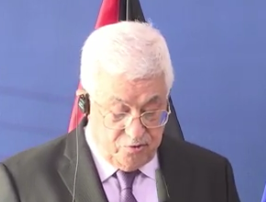
PA President Mahmoud Abbas, addressing the EU in Brussels. Photo: Screenshot.
On September 8, the BBC News website produced its first article dedicated to the topic of the municipal elections that were supposed to have taken place in the Palestinian Authority-controlled areas and the Gaza Strip on October 8, but have been postponed by a Ramallah court.
Prior to the appearance of that article — titled “Palestinian court delays municipal elections after challenges” — the sole reference to those elections at the BBC had been a 14-word-long sentence in a report about a different topic.
One might have assumed that coverage of the first Palestinian election in a decade — in which the rival parties Hamas and Fatah were set to take part — would have been considered essential for the enhancement of BBC audiences’ understanding of Palestinian internal affairs.
The BBC, apparently, thought differently, and thus its audience has received no insight whatsoever into the background of the municipal elections, or the type of campaigning materials put out by the parties involved. Neither have readers and viewers been informed about stories such as Fatah’s nomination of a convicted terrorist as a candidate, or the “concealment” of some female candidates.
In a move that has outraged Palestinian women and various Palestinian factions, a number of Palestinian lists contesting the upcoming local elections, scheduled to take place on October 8, have decided to omit the names and photos of female candidates.
Instead of referring to the female candidates by name and publishing their pictures, the electoral lists are using the terms “the wife of” or “sister.” […]
The decision to conceal the names and photos of female candidates is seen in the context of the increased “Islamization” of Palestinian society, which is already considered highly conservative.
Apart from being a severe blow to the struggle of Palestinian women for equality, the move is in violation of the 2005 Palestinian Local Election Law, which stipulates that candidates must be fully identified by name, age, address and registration number in the electoral list.
This anti-woman undertaking is not taking place only in the Gaza Strip, under the control of the Islamist Hamas movement. It is also baring its fangs in some parts of the West Bank, which is ruled by the Western-funded Palestinian Authority (PA), headed by Mahmoud Abbas.
The BBC’s September 8 report on the postponement of the municipal elections ostensibly informed readers of the circumstances behind the court’s decision.
Thursday’s ruling by the high court in the West Bank city of Ramallah came after a Hamas-controlled court in Gaza disqualified several candidate lists drawn up by Fatah on technical grounds.
A challenge was also lodged by a lawyer over the inability to hold the vote in occupied East Jerusalem, which Israel annexed after seizing it in the 1967 war but Palestinians want to be the capital of a future state.
“Elections can’t take place in one place and not the other,” said the presiding judge.
“The elections can’t take place in Jerusalem and its neighbourhoods. Also, there are problems with the formation of courts in Gaza… Therefore, the court decides to stop the elections.”
However, one relevant aspect of the story is absent from the BBC’s coverage:
Palestinian sources told Haaretz that the election process was seriously harmed when the Gaza courts, which are essentially Hamas-run, decided to annul the lists of candidates associated with Fatah in Gaza.
“These are courts that are illegitimate and they made an illegitimate decision, and so the PA Supreme Court cannot accept a situation in which there are two separate court systems: one in the state of Gaza Strip and another in the state of the West Bank,” they said.
Despite the postponement of the elections having its roots in the Hamas-Fatah split, the BBC nevertheless closed its report by touting the short-lived 2014 “unity deal,” and by making a euphemistic and unhelpful reference to “deep divisions.”
Although Fatah and Hamas formally agreed a unity deal and a technocratic government in 2014, deep divisions remain, resulting in political paralysis.
The BBC itself reported on the unilateral dissolution of that “technocratic government” more than a year ago. Further, In January 2015, the BBC‘s Yolande Knell attributed the failure of Palestinian democracy to “Israeli occupation” in a highly partisan report.
The lack of serious BBC coverage on the background to the 2016 municipal elections once again demonstrates that — despite its obligation to enhance its audiences understanding of international affairs — internal Palestinian affairs are a topic serially and severely under-reported by the self-styled “standard-setter for international journalism.”
Update: A few hours after the appearance of the original version of this post, an article titled “Palestinian women fight elections name ‘censorship’” appeared in the “Features” section of the BBC News website’s Middle East page.