


Syrian Rebels, Russians Said to Be Negotiating End to Ghouta Suffering
Error: Contact form not found.

 by Reuters and Algemeiner Staff

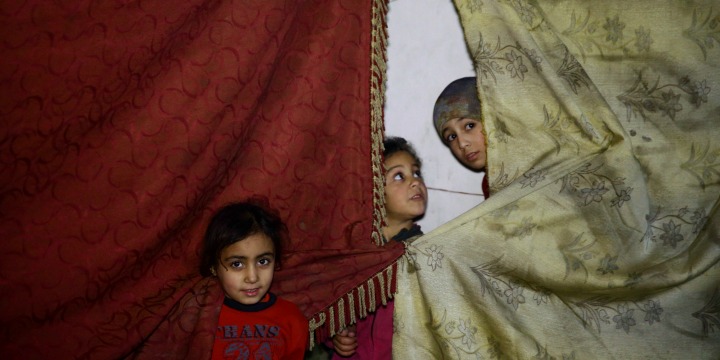
Children stand near curtains in a shelter in the besieged town of Douma, eastern Ghouta, on March 11. Photo: Reuters / Bassam Khabieh.
A Syrian rebel group in one besieged eastern Ghouta pocket said on Friday it would try to negotiate an end to an army assault there, while insurgents in another nearby enclave withdrew.
Ending the opposition’s hold on eastern Ghouta, near the capital Damascus, would represent Syrian President Bashar al-Assad’s biggest blow against the rebels since they were driven from Aleppo in December 2016
Failaq al-Rahman spokesman Wael Alwan said the group would meet Russian negotiators on Friday. He could not say whether the negotiations would lead to the fighters withdrawing. But he told al-Hadath television: “Today is a session to find a solution to end this human suffering, whatever the cost.”
Failaq al-Rahman on Thursday announced their intention to negotiate when Alwan said a midnight ceasefire had been agreed in principle.
The Syrian Observatory for Human Rights said a Failaq al-Rahman delegation left the enclave late Friday morning as guns fell silent after air strikes and advances by pro-government forces had continued past the midnight ceasefire deadline.
The Syrian army’s assault on eastern Ghouta, the last major rebel bastion near the capital, has been one of the most intense in Syria’s seven-year-old war. The United Nations says about 1,600 people have been killed and thousands wounded since mid-February.
The Syrian government and its Russian allies used tactics that had proved successful elsewhere in Syria since Moscow joined the war in 2015 — lay siege to an area, bombard it, launch a ground assault and finally offer safe passage out to rebels who agree to leave with their families.
After helping turn the tide of the war in Syria in Assad’s favor with air power and military support, Russia has increasingly cast itself as a peace-broker within Syria and the wider Middle East. Russian representatives have played a role in negotiating local ceasefires and evacuations.
Eastern Ghouta’s rebels now hold only the town of Douma, under the control of Jaish al-Islam, and another pocket that includes Ein Terma, Arbin and Zamalka, under the control of Failaq al-Rahman.
On Thursday, Ahrar al-Sham rebel fighters withdrew from what had been a third rebel-held enclave in eastern Ghouta, the town of Harasta. They were put on government buses and driven to an opposition-held area of northern Syria.
A second group of fighters began to leave Harasta on Friday in buses. State media said about 1,500-2,000 fighters and their families were expected to leave and said seven buses had left so far.
The Observatory said air strikes also hit Douma, which is controlled by Jaish al-Islam, on Friday and rebels and pro-government forces clashed on the ground.
State television broadcast footage of what it says was about 3,400 people leaving the Douma enclave on foot on Friday morning, carrying small children and belongings. Thousands of civilians have made the same journey over the past week, making their way to reception centers in government-held territory.
The United Nations estimates more than 50,000 people have left besieged areas of eastern Ghouta in the past almost two weeks.
The Observatory estimates a total of about 120,000 civilians have either left the enclave or remained in the towns of Kafr Batna and Saqba, which were re-taken by the government in the past eight days.