









EU Agency Rolls Out Survey of European Jewish Reactions to Antisemitism in 13 Countries
Error: Contact form not found.

 by Ben Cohen


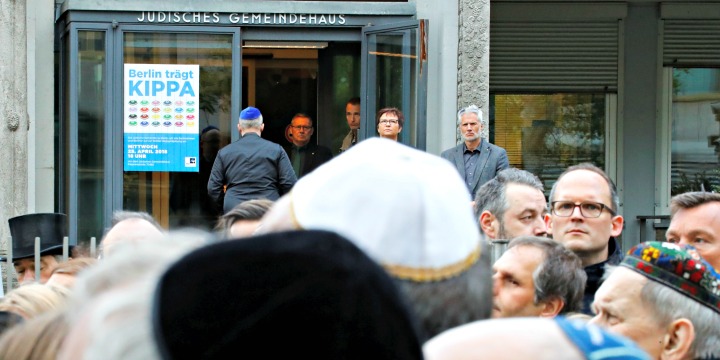
Demonstrators wearing kippot in solidarity with the Jewish community at a Berlin rally against antisemitism in April 2018. Photo: Reuters / Fabrizio Bensch.
Jewish citizens and residents of 13 European Union member states are being urged to fill out on an online survey detailing their personal experiences with antisemitism, as part of a new EU initiative to combat hatred and prejudice toward Jews.
The survey, launched earlier this month, has been organized by the EU’s Fundamental Rights Agency (FRA) in association with two UK-based institutions — the Institute for Jewish Policy Research (JPR), a think tank located in London, and the polling organization Ipsos.
A statement from the FRA said that the goal of the survey was to compile “comparable data on the experiences, perceptions and views of discrimination and hate crime victimization of persons who self-identify as Jewish on the basis of their religion, ethnicity or any other reason.”
The survey is being conducted in Austria, Belgium, Denmark, France, Germany, Hungary, Italy, Latvia, the Netherlands, Poland, Spain, Sweden and the UK. As well as completing the survey in their national languages, respondents also have the option to submit their answers in Hebrew — a reflection, perhaps, of the growing presence of Israeli émigré communities in cities like Berlin and Paris.
Judith Russell — development director of the JPR — told the French Jewish newspaper Actualité Juive that her institute had carried out a similar survey in 9 European countries in 2012, with positive results.
“The results of the 2012 study prompted the European Commission to appoint a coordinator in the fight against antisemitism, and to agree on the definition of the word ‘antisemitism’ on a European level,” Russell remarked. “This new survey can still drive new solutions at European level.”
The survey asks respondents for their opinions about general trends in antisemitism — for example, whether they feel that there has been an increase in antisemitic statements by elected politicians — as well personal experiences of antisemitism at work or at school, or in public places. Initial results are scheduled for release in November.


