





New York Times Book Review Editor Defends Alice Walker Interview
Error: Contact form not found.

 by Ira Stoll

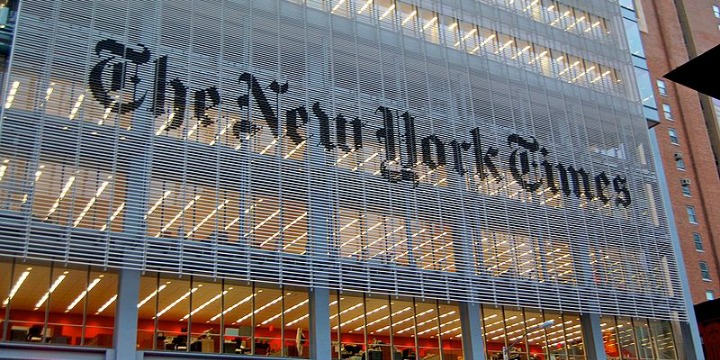
The headquarters of The New York Times. Photo: Wikimedia Commons.
The editor of The New York Times Book Review, Pamela Paul, is pushing back against criticism that she helped to promote an antisemitic book.
The magazine Tablet sparked a furor about the issue on Monday with an article by Yair Rosenberg headlined, “The New York Times Just Published an Unqualified Recommendation for an Insanely Anti-Semitic Book.” In a series of tweets and in an interview with The New York Times “reader center,” Paul argued, in essence, that the Times itself wasn’t promoting the book, but that it was providing readers a valuable service by exposing the proclivities or antipathies of the person who did recommend it, the author Alice Walker.
“What people choose to read or not read and what books they find to be influential or meaningful say a lot about who they are,” Paul said in the reader center interview. “If people espouse beliefs that anyone at The Times finds to be dangerous or immoral, it’s important for readers to be aware that they hold those beliefs. The public deserves to know. That’s news.”
Asked by the reader center whether, in retrospect, she would have handled the Walker “By The Book” column any differently, Paul responded, “No. Readers have certainly learned something about the author and her tastes and opinions. I think it’s worthwhile information for them to know. Our readers are intelligent and discerning. We trust them to sift through something that someone says in an interview, whether it’s the president or a musician or a person accused of sexual harassment, and to judge for themselves: Do I agree with this person?”
Her line of defense was greeted with a large dose of dismay online. “Wow this is a disappointing response,” wrote Blake Eskin, a former online editor of the New Yorker and former cultural editor at The Forward.
On Twitter, respondents publicly doubted whether the Times would apply the same approach to an interview that touted a book hostile to another minority group. Stuart Schnee, a book publicist, wrote, “This answer is SO disappointing. This would never happen if an author suggested an anti African American book or an anti gay book. Would. Not. Happen.”
I know The Algemeiner readership will be disappointed, perhaps even angry to hear it, but on this one, I actually find myself agreeing with Paul. In fairness, it could be that I just am inclined to cut her some slack because I’m a fan of hers dating back to when I first met her in The New York Sun newsroom more than a decade ago, or because I’m an author and The New York Times Book Review is influential.
I’m certainly not one who hesitates to call out The New York Times for anti-Jewish or anti-Israel bias when it is warranted; I’ve practically made a career of it, and certainly it’s tempting here to pile on.
But think about it. Which is a better approach, the one the Times took by running Walker’s interview and letting the chips fall where they have? Or the one it took in similarly formatted “corner office” Business section interview published earlier this month with British vacuum and restroom-hand-dryer businessman James Dyson, in which the Times trigger-warned, “In this interview, Mr. Dyson expressed antiquated and at times offensive views on ‘racial differences’ and Japanese culture. He also referred to growth markets in Asia as the ‘Far East.’ When asked to clarify his remarks, Mr. Dyson declined to comment further”?
I mean, the overall wokeness level of The New York Times is excruciating enough to bear as it is, without the Times heavy-handedly interjecting its own views about opinions expressed by the people it interviews. If people can’t grasp the distinction between an opinion or book endorsed by a person interviewed and an opinion or book endorsed by a news organization itself, maybe the problem isn’t the news organization, but basic news literacy?
If the price for some Times editorial restraint is that sometimes an antisemitic book gets touted without being prominently labeled as such, it may be a good trade-off, because once the Times heads down that route, the demands for even the most mildly Zionist book to be described to readers as Islamophobic will be unrelenting. Sometimes the best journalism does involve just letting interview subjects have their say, without a lot of editorial filtering or commentary.
More of Ira Stoll’s media critique, a regular Algemeiner feature, can be found here.


