




Biden Strikes Against Iranian Targets in Syria Sought to Send Signal Without Escalation, Officials Say
Error: Contact form not found.

 by Algemeiner Staff

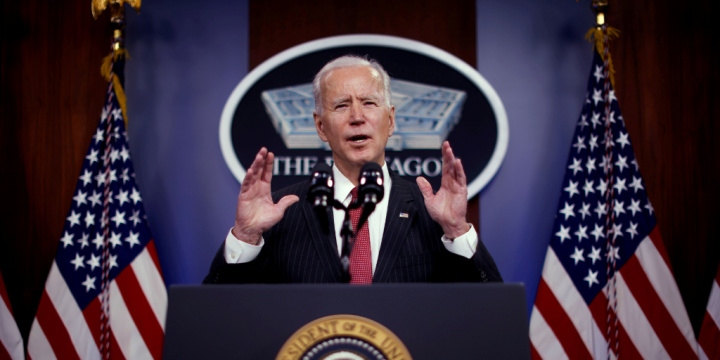
US President Joe Biden delivers remarks to Defense Department personnel during a visit to the Pentagon in Arlington, Virginia, U.S., February 10, 2021. REUTERS/Carlos Barria/File Photo
The Biden administration has said its decision to strike Iran-affiliated targets in Syria last month was taken in order to send the Iranians a message that the US is willing to retaliate against attacks on its personnel even if none were killed, but in a way that would not lead to a major escalation, the Wall Street Journal reported Thursday.
The Feb. 26 strike came in response to a Feb. 15 attack by Iran-affiliated terrorists on coalition forces in northern Iraq that killed a civilian contractor and wounded seven Americans.
To make sure that the Iranians understood the signal the administration was sending, a message was conveyed to Iran, though officials did not disclose its contents to the Journal.
An unnamed official said, “We had a pretty coordinated diplomatic and military plan here. We made sure the Iranians knew what our intent was.”
According to the Journal, officials said the administration also wanted to make clear that the US could respond to attacks even if there had been no fatalities — a departure from the Trump Administration’s explicit “red line” over the death of US personnel abroad.
“We preserve a degree of flexibility for ourselves,” said another official.
Biden reportedly decided on the most restrained military option offered to him: it was deliberately planned not to take place on Iraqi territory and timed for a night attack, as this would likely cause the fewest casualties.
According to the Pentagon, one terrorist was killed in the strike and two others wounded.
The administration took 10 days to consider the strike, attempting to balance competing US interests in the Middle East.
In particular, officials said, they wanted to avoid damaging Iraqi Prime Minister Mustafa al-Kadhimi, who the administration sees as an important partner in fighting ISIS.
However, they said Biden and his advisors also wanted to react relatively quickly, taking a middle way between what they saw as the Obama administration’s tendency to over-analyze and delay and the Trump administration’s tendency toward hasty action.
The attack was initially intended to hit two targets in Syria, but it was discovered just before the strikes were to commence that civilians were present at one of the targets.
Biden chose to call off the strike on that target, even though the F-15Es were already en route, while the other was hit successfully.