



Iran Is Loving Israel’s ‘Government of Change’
Error: Contact form not found.

 by Eyal Zisser / Israel Hayom / JNS.org

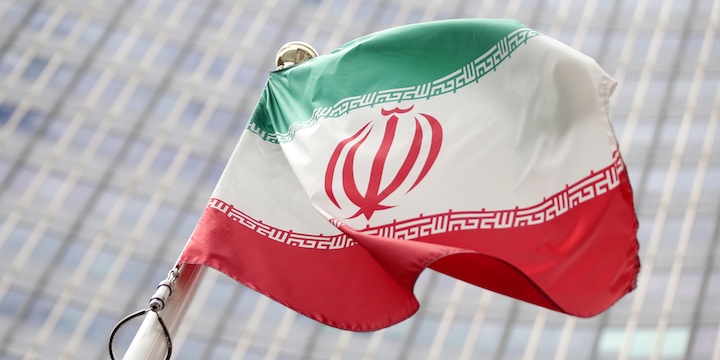
The Iranian flag flutters in front the International Atomic Energy Agency (IAEA) headquarters in Vienna, Austria July 10, 2019. Photo: REUTERS/Lisi Niesner
JNS.org – The political situation in Israel is being closely followed throughout the Arab world. In the past decade, Israel has become a major regional player, and what happens here dictates, or at least influences, how things will play out in the wider region.
It appears that so far the Arab world is keeping mum on the political upheavals in Israel; we aren’t seeing either joy or schadenfreude, nor are we sensing any expectation of or hope for change. Mostly there is weariness at and a lack of understanding of the political games being played, and—more importantly—a certain level of concern about the resulting paralysis that has gripped Israel and the possibility that it might change direction.
A strong and stable Israel is in the interest of many Arab states, even if they aren’t admitting it publicly. For the past decade, they have seen the Israeli government as a stable partner and even as an effective, aggressive ally that sees eye to eye with them when it comes to the regional reality and is determined to join the fierce battle against the emerging Iranian threat.
All this aside, everyone remembers the late Egyptian President Anwar Sadat, who in June 1981 was asked by his staff to call and congratulate “the next prime minister of Israel,” Shimon Peres, on his victory. But Sadat preferred to go to bed. The next morning, he sent warm congratulations to Menachem Begin, his partner in the peace treaty, whom he had preferred to see win. No one in the Arab world is jumping to offer premature congratulations.
In contrast, there is rejoicing in Tehran. The Iranians have rushed to declare “the end of the Netanyahu era,” or as Iranian Foreign Minister Mohammad Javad Zarif put it, its relegation to “the dustbin of history.”
Tehran is convinced that the stars are about to align for it. First, former US President Trump, who placed heavy sanctions on Iran and crushed its economy, was voted out, and then came President Biden, who wants to reach a nuclear deal that will strengthen Iran without it having to abandon its nuclear aspirations. And now Netanyahu might step off the stage after a decade during which he spearheaded an effective, uncompromising fight against Iran in the regional and international arenas.
This is a convenient reality for Iran, which is preparing to wage war for Iraq after the Americans’ expected withdrawal, hoping to bolster its grip on Syria and Lebanon and send its tentacles deeper into the Gaza Strip,
Given all this, it’s no wonder the Arab world is hoping that Israel will see renewed political stability and will continue to cooperate with them on regional problems
Eyal Zisser is a lecturer in the Middle East History Department at Tel Aviv University.
This article first appeared in Israel Hayom.