







Michigan Dem Senate Candidate Admits Own Party Has an Antisemitism Problem
Error: Contact form not found.

 by Corey Walker

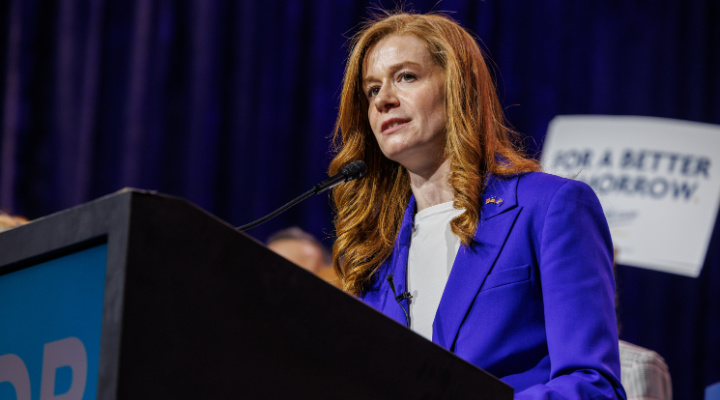
Michigan state Sen. Mallory McMorrow speaks at the Michigan Democratic Party Endorsement Convention in Detroit, Michigan, on April 19, 2026. Photo: Andrew Roth/Sipa USA via Reuters Connect
Michigan state Sen. Mallory McMorrow, who is running for the Democratic nomination for the US Senate, acknowledged during a Thursday primary debate that her own party has a problem of rising antisemitism within its ranks.
When asked by the moderator whether antisemitism is an issue with the Democratic Party, McMorrow promptly responded, “There is.”
McMorrow also recounted a personal experience involving her Jewish husband, saying an individual at the Democratic National Convention allegedly directed an antisemitic slur toward him while he was accompanying their daughter.
“At the Democratic convention, an attendee yelled an antisemitic slur at my husband, who is Jewish and was walking with my five-year-old daughter,” she said. “That is terrifying.”
The comments underscore a broader debate inside the Democratic Party as lawmakers and activists struggle to balance criticism of the Israeli government with concerns about antisemitism. Since the outbreak of the Israel-Hamas war, divisions among Democrats have become increasingly visible, particularly between progressive activists pushing for a harder line against Israel, the closest US ally in the Middle East, and more centrist Democrats warning that some rhetoric has crossed into antisemitism.
Several prominent Democrats, including Pennsylvania Gov. Josh Shapiro and US Rep. Ritchie Torres of New York, have similarly cautioned against language they say unfairly targets Jewish Americans or delegitimizes Israel’s existence.
At the same time, progressive Democrats and pro-Palestinian advocates argue that criticism of Israeli military actions or government policy should not automatically be characterized as antisemitic. Many activists have accused party leaders of conflating opposition to Israeli policy with hostility toward Jewish people. The issue has become politically sensitive ahead of the 2026 midterm elections, particularly in battleground states with sizable Jewish and Arab American populations, including Michigan.
In contrast, Abdul El-Sayed, another contender in the Michigan Democratic Senate primary, blamed antisemitism on so-called “white supremacy” and then accused Israel of “genocide” and “apartheid” during Thursday’s debate,
“So, look, I know what it’s like to be discriminated against because of how I pray, and I know that antisemitism and Islamophobia tend to go hand in hand, and the real issue when it comes to either of them is the scourge of white supremacy,” El-Sayed said. “And I think it’s absolutely critical for us to differentiate between love, respect, and admiration for Judaism and the Jewish people, and a continued policy that has us sending our money to a foreign government. We can walk and chew gum at the same time.”
“For me, when it comes to fighting antisemitism, you are not going to find anybody who is not Jewish who has the same focus on taking that on as somebody who understands that these two things go hand in hand together,” he added. “And, so, we can do that, because we love all people, but it should not mean that we allow our money to subsidize apartheid and genocide against other people because people tell you that that’s about hatred for anybody. That’s about love for everybody.”
Rep. Haley Stevens (D-MI), widely seen as the most pro-Israel choice in the race, did not directly address antisemitism within the party but called attention to “rising political violence and extremism” across the country.
The Senate race in Michigan is expected to become one of the most closely watched Democratic primaries of the cycle, reflecting broader ideological tensions shaping the party ahead of the general election. Polls suggest that the primary competition remains too close to call.