







Opposition Leader: Obama Administration Downplayed Brotherhood Warnings
Error: Contact form not found.

 by Steven Emerson

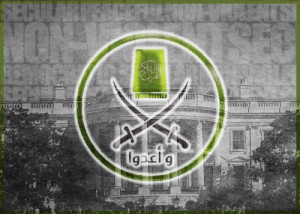 The Obama administration chose to listen to voices suggesting that Egypt’s Muslim Brotherhood was moderate rather than those who warned it would resort to violence if it came to power, cables obtained by the Investigative Project on Terrorism show.
A look at recent headlines involving Egypt’s new Islamist-dominated government makes clear the radical, threatening path its leaders are charting, and that those who urged caution in dealings with the Muslim Brotherhood were prophetic. Criticism of President Mohamed Morsi in the media and among opposition groups leads to criminal investigations. Even a comedian is being targeted.
The Muslim Brotherhood, to which Morsi remains closely tied, routinely threatens Israel and issues anti-Semitic statements.
Meanwhile, Islamists rammed through a new constitution which sparked international concern for women’s and minority rights. Some analysts say the Brotherhood’s actions have pushed Egypt closer to civil war.
The reaction from Washington has been muted at best.
The Obama administration repeatedly ignored and downplayed advance warnings that the Muslim Brotherhood would resort to violent and undemocratic tactics if it came to power, Egyptian opposition leader Michael Meunier tells the Investigative Project on Terrorism (IPT).
For example, a Sept. 20, 2011 State Department cable obtained by the IPT reports on a Muslim Brotherhood representative telling the U.S. embassy in Cairo that the “MB (Muslim Brotherhood) was not the extremist organization the West feared.”
Such assurances have been reflected in comments from Obama administration officials, including the Secretary of State and Director of National Intelligence.
In an April 15, 2010 cable, U.S. Ambassador Anne Patterson reported that Muslim Brotherhood Supreme Guide Mohammed Badie had “reaffirmed the MB was a non-violent” movement.
Director of National Intelligence James Clapper similarly described the Muslim Brotherhood in February 2011 as “largely secular” and said that it “eschewed violence.” Secretary of State Hillary Rodham Clinton listed the Brotherhood’s alleged commitment to nonviolence as among the reasons the State Department planned to expand its contacts with the group in a June 30, 2011 statement.
In the wake of renewed street protests after Morsi’s November decree seizing extrajudicial power, and amid reports of violence and intimidation during last month’s constitutional vote, Clinton and other Obama administration officials have issued tepid and general statements about nonviolence and protecting the rights of all Egyptians.
“The future of Egypt’s democracy depends on forging a broader consensus behind its new democratic rules and institutions. Many Egyptians have voiced deep concerns about the substance of the constitution and the constitutional process,” State Department spokesman Patrick Ventrell said in a Dec. 25 press release. “President Morsi, as the democratically elected leader of Egypt, has a special responsibility to move forward in a way that recognizes the urgent need to bridge divisions, build trust, and broaden support for the political process.”
Foreign Aid Unaffected
However, the administration has been silent on whether Egypt’s march toward theocracy might affect the roughly $2 billion in foreign aid it receives annually from the United States.
U.S. Rep. Ileana Ros-Lehtinen, the outgoing chairwoman of the House Foreign Relations Committee, introduced legislation that would place conditions on foreign aid to Egypt.
“I am extremely concerned that Egypt has moved from one dictatorship to another while leaving democracy in the dust,” Ros-Lehtinen told The Hill. “Morsi has actively worked to suppress the voices of dissent and opposition in Egypt while incrementally increasing his own power.”
Foreign aid should promote our interests, Ros-Lehtinen added, but the Obama administration remains committed to sending a $450 million emergency aid package without trying to influence Egyptian policy.
In an email to the IPT last week, the State Department defended the package as essential for supporting a “democratic Egypt” and for “defeating extremism.”
In contrast, the German government, which may delay plans to forgive up to $316 million in debt because of concerns that Egypt is sliding back into dictatorship.
“There is the danger that the dictatorial system of ousted president (Hosni) Mubarak is returning,” German Development Minister Dirk Niebel told the daily Berliner Zeitung.
Leading those concerns are provisions of the newly passed Egyptian Constitution. Liberal groups such as Amnesty International have roundly denounced it as a threat to human rights.
“The new constitution will guide all Egyptian institutions and it should set out the vision for the new Egypt, one based on human rights and the rule of law: a document which is the ultimate guarantor against abuse. The constitution must guarantee the rights of all Egyptians, not just the majority,” said Hassiba Hadj Sahraoui, Amnesty’s deputy director for the Middle East and North Africa. “But the approved draft comes nowhere near this. Provisions that purport to protect rights mask new restrictions, including on criticism of religion.
She also noted that the constitution ignores women’s aspirations and “blocks the path to equality between men and women.”
Minorities Threatened
The Muslim Brotherhood resorted to fear and intimidation tactics throughout the constitutional referendum process, Meunier says. Ten protesters were killed when Morsi used his own militia to attack opponents. Media opponents have been similarly targeted by Morsi’s militia and subjected to intimidation. Other opponents reportedly have been taken inside the presidential palace and tortured.
“[Brotherhood officials] are using the same language of Mubarak — stability. These guys are thugs. It’s the same thing,” opposition leader Mohamed ElBaradei told Foreign Policy magazine. “At least by what you read, some of the [Brotherhood’s] militias are killing some of these guys [in street clashes] – they are using the same tactics. Except they have beards.”
Egypt’s Coptic Christians, who comprise about 10 percent of the population, face increased discrimination and tens of thousands have already fled Egypt since Hosni Mubarak’s February 2011 resignation.
Copts face prospects of the harsh poll tax known as the jizya and increased discrimination once all of the new constitution‘s provisions are implemented, Meunier says.
He fears that the Islamists intend to use the Copts as scapegoats to provoke a sectarian civil war.
Some Islamists, such as Wagdy Ghoneim, who enjoyed close relations with the Council on American Islamic Relations while he lived in the United States, have issued calls for genocide against the Copts.
“The day Egyptians — and I don’t even mean the Muslim Brotherhood or Salafis, regular Egyptians — feel that you are against them, you will be wiped off the face of the earth. I’m warning you now: do not play with fire!” Ghoneim said in a Gatestone Institute report. “I want to remind you that Egypt is a Muslim country…. if you don’t like the Muslim Sharia, you have eight countries that have a Cross on their flag [in Europe], so go to them. However, if you want to stay here in Egypt with us, know your place and be respectful.”
Egyptian feminists have raised similar concerns over the constitution’s effect on women’s rights.
“It’s a disaster. There isn’t a single article in the draft constitution that mentions the rights of women,” Egyptian feminist Nihan Abu El Konsam told Deutsche Welle. “We lawyers have made numerous proposals for constitutional articles that would make up for the social and cultural problems in our society and would allow women to finally achieve equal rights. But the Islamists ignored it.”
Women suffer discrimination in all areas, especially with regard to income and education, El Konsam said. They also have an unemployment rate four times higher than men, and women also have no protections from domestic abuse.
“When we do go to court, the offender is acquitted,” El Konsam said.
Explicit questions about the Muslim Brotherhood’s commitment to democracy and its commitment to women’s rights and religious freedom for the Copts have been absent in the State Department’s public response.
“You cannot leave out half the population and claim that you are committed to democracy,” Clinton said in her June 30, 2011 address announcing expanded ties with the Brotherhood.
Spokesman Peter Velasco declined to comment when the IPT asked why the State Department had not issued stronger language against the Egyptian government’s role in the violence.
“As we have said in our daily press briefing, we continue to condemn violence of any kind,” Velasco said.
Meunier and other opposition leaders charge that the referendum on the constitution was marred by widespread voter fraud, and that certain voters such as the many of the nation’s Coptic Christians were deterred from voting.
The allegations were substantiated by Egypt’s National Council of Human Rights (NCHR). It received 1,137 complaints of voter irregularities during the referendum process. These included allegations of vote-buying outside of polling stations and a lack of voter lists.
Perception Takes Root
Meunier says he repeatedly warned U.S. embassy officials in meetings over the last few years that the Muslim Brotherhood posed a threat to freedom and democracy in Egypt, but he says his concerns and those of others he knows were dismissed.
Meetings between American officials and the Muslim Brotherhood has created a perception that the U.S. government supports the Brotherhood over other factions, Meunier says.
Another cable dated a July 21, 2011 noted this perception, saying a Muslim Brotherhood opponent had told the embassy that he and others “believed that the U.S. was supporting the Muslim Brotherhood (MB) and wished to see a religious state in Egypt.” – something the embassy denied.
A “handful of meetings was hardly evidence of any endorsement or special relationship,” with the Brotherhood, the cable said. Any notion the United States supported a Brotherhood-led religious state “is absurd.”
But this perception has contributed to a growing anti-American sentiment among Egypt’s secular pro-democracy leaders. U.S. Rep. Sue Myrick, R-N.C., the former chairwoman of the intelligence subcommittee on the House Permanent Select Committee on Intelligence, believes the State Department has refused to acknowledge the Brotherhood’s true nature.
“I do not think they have taken the warnings seriously,” Myrick said. “They also don’t take it seriously that the Muslim Brotherhood is not democratic.”
Cables obtained by the IPT show that other sources made it clear to the State Department that the Muslim Brotherhood was not moderate and that it was being radicalized in the years leading up to Morsi’s June election.
One cable dated Oct. 21, 2009 states that Rafik Habib, a Coptic Christian scholar with close ties to Mehdi Akef, the Brotherhood’s then-supreme guide, informed a political officer at the embassy that the Muslim Brotherhood was not made up of “moderates.”
Habib also served until recently as a member of the Muslim Brotherhood’s political wing, the Freedom and Justice Party, and as an aide to Morsi.
“Habib calls the ‘left wing’ of the MB (Eryan, Fotouh, and to some extent the Deputy Guide Mohammed Habib) pragmatic but cautioned that they should not be viewed as ‘moderates,'” U.S. Ambassador to Egypt Margaret Scobey wrote in the Oct. 21, 2009 cable to the office of Secretary of State Hillary Clinton. “Their goals are the same as ‘conservative’ MB’s; a religious state where Shariah is applied to all aspects of life.”
This section was redacted from the version of the cable obtained by IPT through our request under the Freedom of Information Act, but was retrieved through a search of the Wikileaks database.
The radicalization of the Muslim Brotherhood’s younger members, and the rise of more radical Islamists, was noted in several other 2009 cables.
The Salafi influence in Egyptian politics was rising and “younger members of the Brotherhood were becoming increasingly Salafi-oriented,” Scobey noted in a Feb. 4, 2009 cable.
Muslim televangelist Moez Massoud told embassy personnel he feared “combination of Salafist ultra-orthodox Islam with MB political activism,” Scobey noted in a May 27, 2009 cable.
Massoud’s fear reached fruition in October 2011 when the Muslim Brotherhood and radical Salafists announced an alliance to help transform Egypt into an Islamic state.
Other cables show that the State Department knew about the Muslim Brotherhood’s theocratic designs in 2007 – well before Mubarak looked vulnerable.
Its desire to impose an Islamic theocracy was noted by the U.S. embassy in a July 11, 2007 cable by then-U.S. Ambassador to Egypt, Francis Ricciardone, observing that the group’s political platform sought “to amend laws and make them accordant with Islamic shari’a.”
The platform was not simply about setting forth the Muslim Brotherhood’s ideas, but “[r]ather, it was conceived of to ‘manage the affairs of society and people,'” Ricciardone noted in an Oct. 24, 2007 cable.
That year, Middle East scholar Mohamed Elmenshawy warned that the platform’s insistence on the creation of a Council of Islamic Scholars could turn Egypt into Iran.
“Perhaps the most alarming feature of the draft platform is the call to create a Majlis Ulama, or Council of Islamic Scholars, that could end up being elected by Islamic clerics, not through free and fair elections,” Elmenshawy wrote in the Christian Science Monitor. “Reminiscent of Iran’s Guardian Council, this undemocratically selected body could have the power vested by the state to veto any and all legislation passed by the Egyptian parliament and approved by the president that is not compatible with Islamic Shariah law.”
Opposition leaders such as Meunier see similarities to Elmenshawy ‘s concerns in Article 4 of the recently passed constitution. It requires that Al-Azhar University’s senior scholars be consulted on matters pertaining to Islamic law.


