Preparing for the Fall of Jordan
Error: Contact form not found.

 by Yoel Meltzer

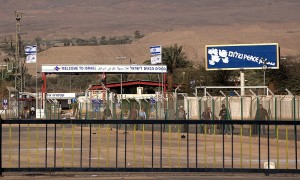
Arava Aquaba checkpoint along the Jordan-Israel border. Photo: wiki commons.
As the bloodshed in Syria continues with no end in sight, more and more eyes are beginning to focus on Syria’s formerly stable southern neighbor, Jordan. After nearly two years of low level protests, the last few months have witnessed not only an upsurge in the amount of protests but also a significant change in the makeup of the protesters themselves.
For starters, Jordan’s large Palestinian population, a group which comprises roughly 70% of Jordan’s total population, has finally entered the fray with many in this somewhat disenfranchised community openly calling for the king to be ousted. Equally significant, the Muslim Brotherhood, a group that traditionally has been treated well by the king, has also begun to take part in the escalating protest movement. However, unlike the Palestinians, the Muslim Brotherhood is not calling for the king to be toppled but rather for the regime to be reformed. Although they clearly understand that the king is slowly losing his grip on power, tactically it’s in their interest to gradually gain control via reforms instead of taking a chance with the all-out chaos that is likely to prevail should the king suddenly fall.
With the post-Mubarak Egypt already in the hands of the Muslim Brotherhood, coupled with the Hamas regime in Gaza and the Hezbollah domination of Lebanon, western and Israeli leaders are understandably concerned about the future in Jordan. The question is, what should they do?
While some will suggest that the king needs to be supported at all costs in order to maintain the relatively peaceful border with Israel, this approach seems short-sighted since it’s only a matter of time before the unstoppable events which have been sweeping the region for the last two years will finally bring down the king and end the Hashemite rule in Jordan.
Another option is to simply stand aside and do nothing. However, since the Muslim Brotherhood, thanks to its close association with the king, already has the inside track for gaining power in the post-Hashemite Jordan, and due to the fact that a similar course of action in Egypt backfired and brought Morsi to power, this approach also does not seem to be the most prudent.
Thus, the only logical option is to strengthen the large Palestinian population and to facilitate their rise to power in such a way as to prevent yet another needless civil war and bloodbath in the region. Moreover, by already forging contacts with various Palestinian leaders in Jordan, the seeds can be set for the development of the Arab world’s first true democracy. Finally, regarding the king, it’s a near certainty that if done peacefully he and his family will be granted asylum in a European capital, a fate infinitely better than that of either Mubarak or Gaddafi.
The question is, will the world sit idly by and allow yet another Arab country, one that is bordered by a warring Syria to the north and an unstable Iraq to the east, to either be taken over by Muslim fundamentalists or to deteriorate into civil war and bloodshed? Or will they spend a tiny fraction of the time and money that is invested in endlessly trying to force Israel to accept the ill-advised and impractical two-state solution to help develop a stable Palestinian state east of the Jordan River, one that can be developed to satisfy the national aspirations of the Palestinians and in doing so finally lay the groundwork for solving the supposedly unsolvable Arab-Israeli conflict?
This article was originally published by Ynet.