





Bernard-Henri Lévy: Israel, Palestine, and the French Legislature: ‘He Who Would Act the Angel, Acts the Brute’
Error: Contact form not found.

 by Bernard-Henri Lévy

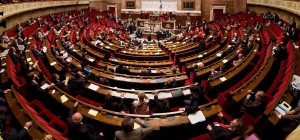
France's National Assembly. Photo: Wikipedia.
For nearly half a century I have favored the two-state solution. But I believe that the “unilateral recognition” of Palestine under consideration in the French parliament is a bad idea for three reasons.
1. Hamas.
Its charter and its agenda.
The fact that, for the time being at least, Hamas administers one of the two territories that make up the state that supposedly must be recognized immediately and with great fanfare. The fact that Hamas’s doctrine is that Israel must be destroyed.
One does not recognize, even symbolically, a state in which half of the government denies another state’s right to exist.
One does not recognize, especially not symbolically, a government in which half of the ministers dream of annihilating that state.
One extends a hand to its people, of course. One provides help. One supports and reinforces the other party, that of Mahmoud Abbas, and encourages it to break the unnatural alliance into which it has entered. But as long as that alliance remains intact; as long as Hamas remains Hamas; as long as a part of the state that one is preparing to recognize recognizes itself in a charter that orders all Muslims to come out from “behind the rocks and trees” where they are “hiding” to “kill … Jews” (article 7 of the charter); as long as Hamas professes (article 13) that “the supposed initiatives” and “peaceful solutions,” such as the current proposal in France, that would “settle the Palestinian question” are contrary to the faith, one must defer recognition.
2. The timing.
The worldwide rise of jihadism.
And the fact that the Palestinian political class and, alas, its civil society (not just Hamas), seem once again to be unclear on the question.
I am not referring to Mahmoud Abbas, who condemned the November 18 attack on a synagogue in West Jerusalem that left five people dead.
But I am referring to his allies in the PFLP who took credit for it. I am referring to the Islamic Jihad and, again, Hamas, which praised it.
And I am thinking of those thousands of young people who, as soon as the news became known, came out into the streets to light fireworks and celebrate.
One day, perhaps, a majority of Israelis may come to believe that the least bad form of protection against this situation is a clean break. But that will be their decision, not the decision of a Spanish, English, Swedish, or, now, French parliament improvising a hasty, ill-founded, and, above all, inconsequential resolution.
One cannot be horrified at the decapitations in Iraq and then dismiss murders with knives and hatchets in Israel.
One cannot, at one moment, reject the rhetoric of excuses (“those who have gone to fight in Syria are lost souls, victims of social malaise…”) and, the next moment, indulge in it (“the killer was humiliated, a victim of the occupation…”).
One cannot, with the right hand, strengthen the legislative arsenal that makes it possible for Europe or the United States to combat blind violence, then, with the left, approve a resolution that basically says “we understand” to aficionados of the ram raid hoping for a third Intifada.
There will be a state in Gaza and Ramallah. That is in Israel’s interest and it is the Palestinians’ right. But our involvement is justified only if we demand equal effort from both parties. From South Africa’s ANC to the Kurdish PKK, and including Menachem Begin’s Irgun, history is full of terrorist organizations that changed their tactics and spirit. We are waiting for Palestinian groups to follow the same path—and it is toward that goal that men and women of good will in France and elsewhere should work.
3. Because this is the essence of the problem.
No honest observer can ignore the fact that both sides have a long way to go.
No advocate of peace denies that between the governments in Jerusalem, which, from Rabin to Netanyahu, have never renounced the settlements policy, and a Palestinian leadership that has oscillated between accepting Israel as a fact and rejecting any Jewish presence on Arab land, there is blame enough to go around.
But that is precisely what the proponents of unilateral recognition deny.
It is very precisely what they forget when they go around saying “we can’t take anymore of this” and “it is urgent that things move forward,” or that a “strong gesture” is needed in order to “apply pressure” and “unblock the situation,” and that no better “strong gesture” can be found than to impose on Netanyahu a non-negotiated Palestinian state.
And that points to the last critique to be laid against them: Their reasoning presupposes that there is only one blockage (the Israeli one) and only one party that needs to be pressured (Israel), and that nothing needs to come from the Palestinian camp—literally nothing: Stay put; take no initiative; whatever you do, do not demand the revocation of a Hamas charter that drips with hate for Jews and contempt for international law—because, hey, now you have your state.
It is hard to tell which is greater in this case: hostility to Israel, contempt for the Palestinians, or lack of seriousness. But one thing is certain. Without shared responsibility, there will be no shared land. By excusing one side from its historical and political burden, we may believe that we are seeking peace; in fact, we are perpetuating war.
Bernard-Henri Lévy is one of France’s most famed philosophers, a journalist, and a bestselling writer. He is considered a founder of the New Philosophy movement and is a leading thinker on religious issues, genocide, and international affairs. His 2013 book, Les Aventures de la vérité—Peinture et philosophie: un récit, explores the historical interplay of philosophy and art. His new play, “Hotel Europe,” which premiered in Sarajevo on June 27, 2014, and in Paris on September 9, is a cry of alarm about the crisis facing the European project and the dream behind it.
Translated by Steven B. Kennedy