



State Department on the Defensive After ‘NY Times’ Report Casts Doubt on Iran’s Commitment to Nuclear Deal
Error: Contact form not found.

 by Eliezer Sherman

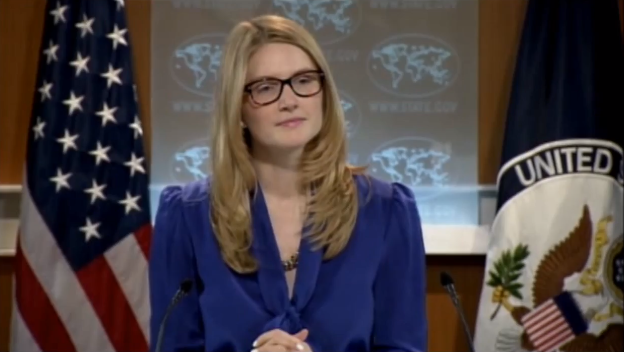
U.S. State Department Deputy Spokesperson Marie Harf said the State Department was ‘perplexed’ over a NY Times story regarding an increase in Iran’s nuclear fuel stockpile. Photo: Screenshot.
The Obama administration went on the defensive on Wednesday over a New York Times article published the day before, which claimed that Iranian nuclear fuel stockpiles had grown 20 percent in the last 18 months, flying in the face of the interim nuclear agreement.
State Department Spokeswoman Marie Harf sent a flurry of messages on Twitter to one of the article’s co-authors, claiming that the “main contentions of your story are wrong.”
“You write that ‘Western officials and experts cannot quite figure out why’ Iran’s stockpile is at this level – not true,” she wrote, referring to the main argument of the Times’ piece, namely that Iran’s boosting of nuclear fuel stockpiles challenged the White House’s attempt to secure a nuclear deal by the June 30 self-imposed deadline.
Harf then followed up with several more messages, “You write that ‘The overall increase in Iran’s stockpile poses a major diplomatic and political challenge’ – not true. You write that this partially undercuts our contention that the Iranian program has been ‘frozen’ – not true. And you insinuate Iran is doing something it’s not supposed to do under the [Joint Plan of Action] or in violation of its obligations – not true.”
But critics of the pending nuclear deal, which would be based on the framework announced in Lausanne, Switzerland by negotiators from Iran and world powers say Iran has reneged several times on the commitments it agreed to in the Joint Plan of Action, the official name for an interim deal announced in 2013.
For example, Iran was found to have been pumping uranium into an advanced centrifuge, which the White House ultimately dismissed as an accident.
Critics also say that the interim agreement was drafted to be deliberately weak to make it easier for Iran to follow its guidelines, such as not prohibiting the acquisition of nuclear equipment. Earlier this week, Russia announced it was helping develop a new nuclear facility in the country.
Negotiators from Iran, the U.S., U.K., France, Germany, Russia and China are pushing to finalize a nuclear deal by June 30 that would see the lifting of international sanctions, which were imposed to prevent Iran from obtaining a nuclear weapon.