



Music to Barenboim’s Ears
Error: Contact form not found.

 by Ruthie Blum

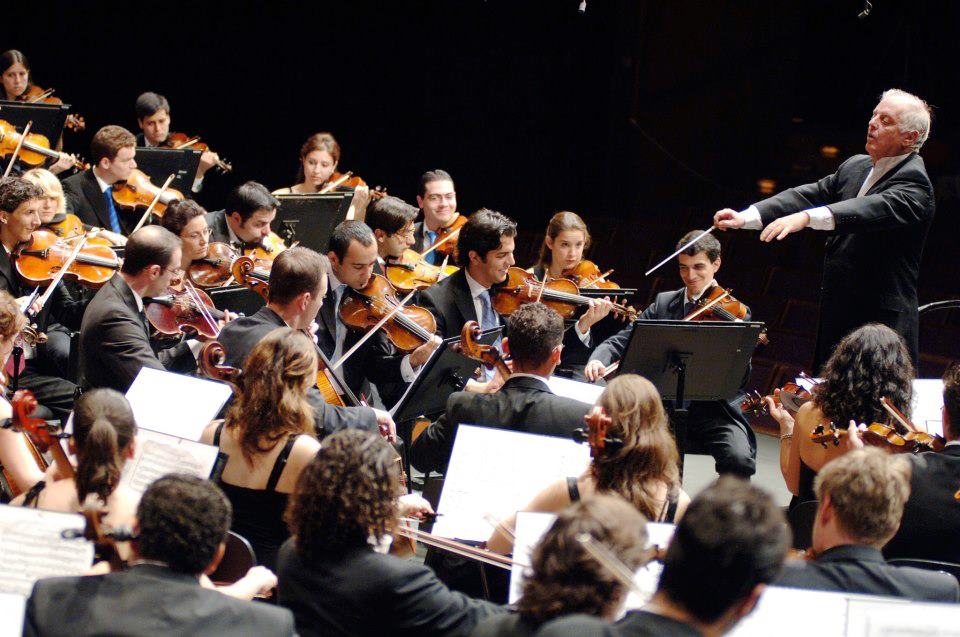
Daniel Barenboim performing.
It’s been a while since renowned pianist and conductor Daniel Barenboim took center stage in an international controversy.
Luckily for the 72-year-old expatriate (whose family moved to Israel from Argentina when he was nine, and who has spent the bulk of his career in Germany), his political views can always be counted on to give his baton a boost.
This week, the general music director of the Berlin State Opera and its orchestra, the Staatskapelle, announced his plan to take the show on the road to the Islamic Republic of Iran, in the wake of the nuclear agreement reached between Tehran and six world powers in July.
Because the mullah-led regime in Tehran views Western music as one among many threats to its reign of terror, however, the best Barenboim can do is “negotiate” a potential concert.
Of course, he cannot undertake this on his own. Such delicate affairs of state have to be orchestrated, literally and figuratively, by governmental bodies with the authority to engage in talks over such a sensitive matter.
According to a press release from the Staatskapelle, such talks are indeed underway between cultural officials in Germany and Iran.
In addition, the Staatskapelle said, “German Foreign Minister Frank-Walter Steinmeier has taken on the patronage of this concert and supports Daniel Barenboim’s commitment to make music accessible to people beyond any national, religious or ethnic boundaries.”
Interesting choice of words from Steinmeier, taken right out of the mouths of Barenboim and his buddy, the late Palestinian-American intellectual Edward Said. Together, Barenboim and Said, whose revisionist history of his own life calls the rest of his scholarship into question, founded the Seville-based West-Eastern Divan Orchestra in 1999.
The goal of the summer program was to bring young Arab and Israeli classical musicians to play together in Spain — “to promote mutual reflection and understanding.” But the only thing “mutual” about Barenboim’s and Said’s “reflection and understanding” was a shared pro-Palestinian worldview.
In 2000, for example, Said took a trip to Lebanon, where he threw a rock over the border at an Israeli military guard post. Said, a professor at Columbia University, later said his violent action was “a symbolic gesture of joy.”
In 2001, Barenboim broke an informal Israeli taboo on performing the music of Nazi-beloved composer Richard Wagner at the Israel Festival in Jerusalem. This was after promising to back down from his original intention to do so when it caused an uproar in the country, filled with many Holocaust survivors. So what he did was wait until the end of the concert, inform the audience the orchestra was going to play a piece from Wagner’s opera “Tristan and Isolde,” and said that anyone who might be offended was welcome to exit the premises.
In 2005, when in Israel presenting “Parallels and Paradoxes: Explorations in Music and Society,” a book he co-authored with Said, Barenboim refused to be interviewed by Army Radio reporter Dafna Arad because she was wearing an IDF uniform.
That same year, Barenboim delivered the inaugural Edward Said Memorial Lecture at Columbia, during which he called on Israel to accept the Palestinian narrative “even though they may not agree with it. … The State of Israel was supposed to provide the instrument for the end of antisemitism. … This inability to accept a new narrative has led to a new antisemitism that is very different from the European antisemitism of the 19th century.”
These snippets are drops in Barenboim’s bucket of offensive activities and radical politics. This is why it is pointless for Israeli Culture Minister Miri Regev to make a stink about his latest maneuver, as she has been doing.
In the first place, Barenboim is not the only one desiring entry into Iran right now. A German delegation has already graced the place; the U.K. has reopened its embassy in Tehran; and businessmen and “rapprochement” fantasists alike have been flocking in droves for a foothold there.
And Barenboim’s overall ideology makes him an obvious member of the lunatic Left, which ostensibly champions human rights while apologizing for the greatest abusers of it.
Furthermore, in light of repeated statements from Iranian officials reiterating the regime’s intention to destroy Israel and continue to view America as the “Great Satan” — an enemy with which it signed a pact enabling it to proceed with its nuclear weapons program — Barenboim’s advances could well be rejected.
He is a Jew with Israeli citizenship, after all.
Ruthie Blum is a Tel Aviv-based author and journalist. This article was originally published by Israel Hayom.