




Anti-Israel Speakers Promote BDS to Loud Applause at UC Berkeley Lecture
Error: Contact form not found.

 by Cinnamon Stillwell

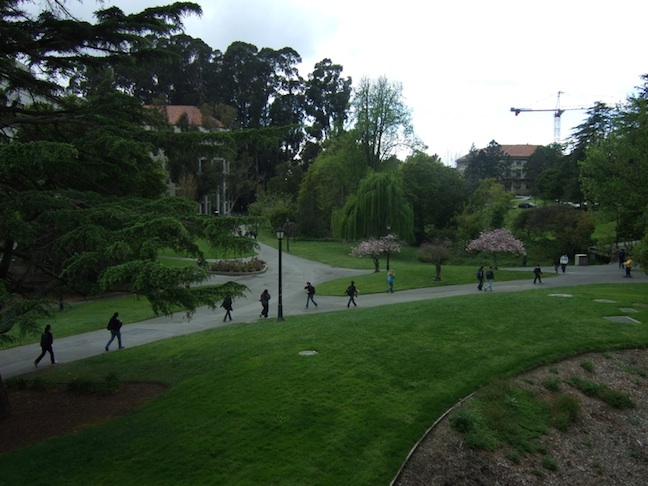
The campus of the University of California, Berkeley. Photo: Wikimedia Commons.
Cheryl Davila, a member of a Berkeley, California city commission that is ostensibly devoted to the “social welfare needs” of “low-income residents,” was recently dismissed after introducing a boycott, divestment, and sanctions (BDS) resolution against Israel. Now she has found a champion in U.C. Berkeley Department of Near Eastern studies (NES) lecturer Hatem Bazian.
Bazian provided the introduction to a September 18 lecture co-sponsored by U.C. Berkeley, which was delivered by Omar Barghouti, co-founder of the Palestinian Campaign for the Academic and Cultural Boycott of Israel (PACBI).
Before introducing Barghouti, Bazian rallied the audience to the “cause” of Cheryl Davila. Davila was removed from her post last month by City Councilman Darryl Moore, who appointed her in 2009, because she refused to withdraw the “Divestment From the Israeli Occupation” resolution she sponsored. Moore alleged that Davila neglected to notify him about the controversial proposal and claimed it was a misuse of the commission.
Davila was in the audience, and after introducing her to loud applause, Bazian blamed her removal on a bias against anti-Israel activists:
[T]his is the type of democracy you face when you deal with Palestine. I will say that you [the commission] have a progressive agenda except when it comes to Palestine.
He then made a ludicrous comparison between Davila’s situation and that of civil rights leader Martin Luther King Jr., whose opposition to the Vietnam War, Bazian claimed, culminated in his assassination:
Seventy-seven percent of the American public was against Martin Luther King. . . . Most of the newspapers nationally were against Martin Luther King because he opposed the Vietnam War. Therefore, today, you have the Martin Luther King building here; you have the street . . . in downtown Berkeley. We have many streets and many schools across the country. MLK was right. And, Cheryl, in your resolution, you were right and history will prove you right.
Bazian, director of U.C. Berkeley’s Islamophobia Research & Documentation Project, is accustomed to melodramatic claims of victimhood, evidence to the contrary notwithstanding. He is also the founder of the radical anti-Israel group Students for Justice in Palestine (SJP), a point of pride driven home by his admonishment to reporters in attendance: “At least historically be accurate: SJP was created on this campus in 1992.”
A proponent of the BDS movement, Bazian urged audience members to “sign the mailing list” for the U.S. Campaign for the Academic and Cultural Boycott of Israel (USACBI), another co-sponsor of the lecture that counts a good number of Middle East studies academics among its organizers and endorsers. Engaging in predictably spurious comparisons between Israel and apartheid-era South Africa, Bazian disdained any move, then or now, towards “constructive engagement.”
Barghouti followed by explaining that BDS is something “any decent liberal” should support. If one were to judge by Barghouti’s delivery alone, which was calm, measured, and, at times, humorous, his proposal to single out the world’s lone Jewish state for an economic boycott would appear entirely reasonable.
He claimed that BDS “targets institutions, not individuals”; thus, it’s acceptable for “an Israeli professor” to be “invited to teach at Berkeley,” given that there is no “agreement with an Israeli university” or any “institutional links.” Barghouti asserted that such a boycott constitutes a mere loss of “privileges,” not a “threat to academic freedom.”
Of PACBI’s role in the American BDS movement, Barghouti bragged that “spreading the academic boycott to U.S. academic associations” has been its primary achievement. The significance of the Modern Language Association, the American Studies Association and others considering BDS resolutions means that the “taboo” of discussing “Israel and boycott in the same sentence” has been “shattered.”
For around 20 minutes during Barghouti’s lecture, a small group of student protesters stood silently in the front of the room with signs reading, “Banning the Ideas of One Nation Is Discrimination” and “U.C. Berkeley Academic Departments Support Limiting Academia.” Neither Barghouti nor the audience acknowledged their presence, and it was a far cry from the disruptive protests, heckling and violence that has met pro-Israel speakers on campus.
A version of this article was originally published by Frontpage Magazine.