




Ahead of Celebrations Marking 500th Anniversary of Protestant Reformation, Calls Made to Remove ‘Jewish Pig’ Sculpture From German Church Where Martin Luther Preached
Error: Contact form not found.

 by Algemeiner Staff

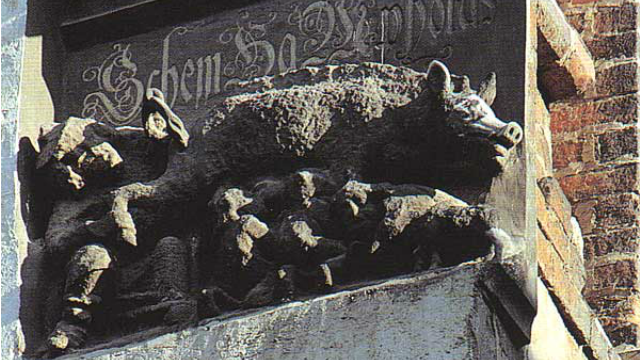
The ‘Judensau’ sculpture in question on the St. Mary’s Church in Wittenberg, Germany. Photo: Wikimedia Commons.
Ahead of festivities next year to mark the 500th anniversary of the Protestant Reformation, calls are being made to remove an antisemitic sculpture from the façade of a church in Wittenberg, Germany where Martin Luther preached, Christianity Today reported on Wednesday.
One outer corner of St. Mary’s Church, the report said, features a “14th-century sandstone sculpture of a pig with two people in identifiably medieval Jewish hats suckling at its teats and another holding a piglet’s ear.” Furthermore, “[a]n additional Jewish person lifts the tail while looking into the sow’s rear.”
Inscribed above the sculpture are the words “Rabini Shem Hamphoras” — which Christianity Today called a “nonsensical reference to the Jewish appellation of God’s name, added after Luther’s time” that “quotes a derogatory comment in one of Luther’s writings.”
74-year-old Lutheran Sister Joela Krüger — described as a leader of the campaign to remove the sculpture from the church — was quoted as saying, “The Judensau (Jewish pig) grieves people because our Lord is blasphemed. And also the Jews and Israel are blasphemed by showing such a sculpture.”
According to the report, around 30 such “Jewish pig” sculptures remain on churches around Europe, mostly in Germany.
Around 80,000 people visit St. Mary’s Church — a UNESCO World Heritage Site — annually, the report said, and the sculpture in question was recently cleaned up “as part of a 7.5-million-euro church restoration effort” in preparation for next year’s celebrations of the 500th anniversary of the Protestant Reformation that are expected to draw one million tourists to Wittenberg.
Luther — the initiator of the Protestan Reformation — sought “to suppress the Jews, to make Jewish life impossible [and] to expel them from the places where Christians live,” University of Göttingen Professor Thomas Kaufmann was quoted as saying. And in the 20th century, the report said, Nazi propagandists made use of Luther’s antisemitic sentiments.
In November 1988 — on the 50th anniversary of Kristallnacht — the church installed a Holocaust memorial plaque “to counteract the ‘Judensau,’” the report noted.
A local German Jewish leader told Christianity Today that the sculpture should be kept on the church to remind people of antisemitism.
“We think that the sculpture represents a testimony of medieval thinking and Christian architectural tradition,” Max Privorozki, chairman of the executive committee of the association of Jewish communities in the state of Saxony-Anhalt, was quoted as saying. “There is no doubt that the 14th-century ‘Judensau’ sculpture at Wittenberg is unseemly, obscene, insulting, offensive, libelous, and a portrayal of hate speech and anti-Semitism and that it defames Jewish people and their faith. However, it should be seen within the context of the time period in which it was made.”