





Rigid Orthodoxy Is Destroying Religion
Error: Contact form not found.

 by Jeremy Rosen

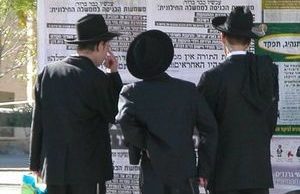
Haredim viewing a modesty decree in Jerusalem. Photo: Wikimedia Commons.
I’ve always thought it was important to read opinions that conflict with mine, either to confirm my position or perhaps force me to reconsider it. A thinking person should always be prepared to examine his or her received opinions. So it was with eager anticipation that I read Lesley Hazleton’s Agnostic: A Spirited Manifesto.
I have known Lesley for a very long time; she is a very talented writer who has always held strong, contrary opinions, which she fearlessly expresses. I was not entirely surprised, therefore, to discover that I agreed with almost everything she wrote.
In general, I approve of Voltaire’s famous line, “Doubt is not a pleasant condition but certainty is an absurd one.” I am sure that is true of intellectual ideas — less so about emotions, of course. Although they, too, can often be just as misleading.
One of the things I like least about Orthodoxy as currently practiced is the absurd certainty that so many rabbis and scholars have about issues of true debate. Great minds like Maimonides, Nachmanides, Yehuda Halevy and Abarbanel, to mention only a few, were prepared to say that there were things they did not understand within the corpus of Jewish ideas — and that even the prophets did not know the details of some of the ideas they preached. And that was precisely why there were so many different interpretations on such nonrational issues as the afterlife and resurrection.
Many theological issues are simply beyond us in rational terms. Yet children and adults are taught in religious schools or evangelical centers that they have to accept literal explanations; further, they are often dissuaded from asking questions. This can lead to one of two possibilities: blind, unconsidered acceptance or rejection. Sadly, it is often the brightest who reject religion, and who can blame them? It is not surprising that such certainties have turned people off to organized religion?
Doubt is exciting and necessary when it accompanies an open mind. The Torah encourages children to ask why. The Seder revolves around asking questions. The Talmud in Sukkot gives four quite contradictory interpretations of why we sit in a Sukkah. Is only one of them “the truth”? No one should be asked to believe in anything that doesn’t make sense to them on some level. But if the answer is, “Shut up and accept what I say without challenge,” a lively mind will just switch off.
Challenge popular myths, and you will not be thanked. I have noticed that if I ask people to explain what they believe, they become uneasy and defensive. If I am critical of religious shortcomings, I often get the response, “Don’t we have enough enemies without you undermining religious faith?” As Ms. Hazleton points out, those who claim to possess certainty often hate to be challenged. She quotes Samuel Johnson, “Every man who attacks my belief diminishes in some degree my confidence in it, and therefore makes me uneasy; and I am angry with him who makes me uneasy.” And that’s why religious rationalists get attacked so fiercely too, not just by fundamentalists but by ordinary people who want to feel secure in their belief that they are absolutely right.
Questioning does not necessarily undermine. It can help clarify. Finding gaps or problems with evolution does not necessarily prove that it was God who created the world. Antony Flew, the most famous atheist of my youth, now says he cannot believe the universe came about by accident. Neither can I. But that still doesn’t tell us who or what designed it.
I do find the agnostic position compelling. It contrasts to the absurdity of the atheist certainty that there is no higher power. “I know for certain” always rings danger bells. What is wrong with saying “I honestly do not know”?
There are some minor cavils in her book. For example, to say that the great Kabbalist Isaac Luria is the father of Kabbalah is rather like saying Martin Luther is the father of Christianity. It gives the impression of undervaluing all that went on before. Nevertheless, her book draws on Jewish and other sources from religion, philosophy, psychology and literature to create an entertaining and stimulating flow of ideas. It is a beautifully written, serendipitous exploration of doubting, questioning and allowing for the possibility of surprise.
And in our hectic life, having a row of festivals as we now do is a perfect time for us to wonder why and to what end.