




Why a Yazidi Woman in Iraq Named Her Newborn Son Trump
Error: Contact form not found.

 by Paul Miller

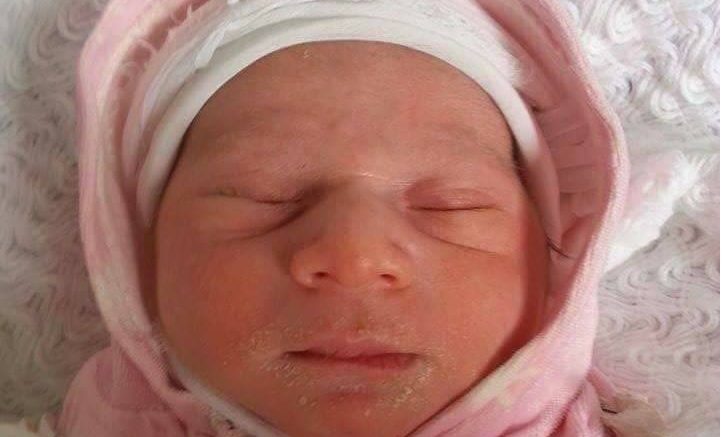
Baby Trump. Photo: Undisclosed for security reasons.
As the votes were being counted throughout the United States Tuesday night, a Yazidi woman in Iraq was in labor, finally giving birth to a baby boy an hour before Donald Trump was declared the winner. An hour later, mom and dad named their beautiful child “Trump.”
This story begins over two years ago, when the same Yazidi mother was pregnant with her first child and ISIS attacked the village where she and her husband (names withheld due to safety concerns) planned to raise their family. Running for their lives, they escaped to Sinjar Mountain where they, along with thousands of others, were stranded with no food or water for seven days. Lacking the essentials and surrounded by ISIS, the mother gave birth to Dilbreen in that mountain camp on January 4, 2015.
One year to the day later, Dilbreen was asleep in a tent, with thousands of other displaced Yazidis, when a gas heater malfunctioned and a fire broke out. With mom outside baking bread for her son’s birthday, she was unable to protect him from the burning plastic ceiling that melted and fell on the child.
Dilbreen was lucky to survive, but had to endure the pain and disfiguration caused by severe burns to his face.
The Yazidis are mostly a forgotten people. Nearly a year ago, the world watched in horror as ISIS attacked a Paris nightclub. When the carnage ended, 130 people were dead and over 350 more injured. At exactly the same time, 2,500 miles away, ISIS was slaughtering Yazidi men, women and children in the Iraqi town of Sinjar — scene of the infamous Sinjar massacre 15 months earlier, in which 200,000 Yazidis were driven from their homes and 50,000 fled for their lives to the Sinjar Mountains.
At the time, I told that story in the Observer and introduced to the world a courageous Yazidi woman named Adlay Kejjan, who works with the pro-Israel organization StandWithUS and a cross-section of religious communities to bring awareness to the plight of the Yazidis.
With the help of other Yazidis living in the US, Kejjan has launched the nonprofit Yazidi American Women Organization on behalf of thousands of women and girls enslaved by ISIS. Because of their efforts, Dilbreen is getting the care he needs.
“Shriners Hospital for Children in Boston agreed to do reconstructive surgeries on Dilbreen’s face. The UK’s Road to Peace organization brought Dilbreen to the United States,” explained Kejjan. “After surgery on his chin and bottom lip, Dilbreen can now close his mouth and eat food.”
Kejjan continued, “Dilbreen needs many more surgeries on his face…with everyone’s help and prayers, we hope to get him better fast.”
Dilbreen’s injury is all too common in the Yazidi camps. “The only source of warmth these families have are these dangerous small gas heaters and it’s commonplace for their tents to catch fire,” explained Kejjan. “There are hundreds of children who desperately need medical attention for their burns and surgery to repair disfigurement. Right now, the Yazidi American Women Organization does not have the resources to come close to helping every child in need.”
Earlier this year, Kejjan visited Iraq for six weeks to see the current plight of her people for herself – a suffering that gets little attention from a world focused only on Syrian refugees.
When Kejjan returned to the United States, she became Dilbreen’s guardian. His father, mother and baby brother Trump hope to join him in America soon.
“We have been going through a never-ending genocide over the last two years at the hands of ISIS, and Obama failed to take out ISIS or help liberate the thousands of Yazidi women and children that are still enslaved by ISIS,” said the father of Dilbreen and Trump, translated by Kejjan. “I hope President Trump will at last take out ISIS so we can return home and rebuild our lives.”
ISIS is reportedly holding 3,200 Yazidi women and girls as sex slaves. Over 5,000 have been killed and 400,000 displaced by the terror group. These numbers reflect only the towns liberated by Yazidi and Kurdish fighters backed by US- and British-led coalition air strikes.
According to Kejjan, death tolls are reflected in mass graves found after towns are liberated. Less than half of Yazidi towns have been liberated. If and when the rest are set free, the death toll and the number of kidnapped and injured are expected to rise dramatically.
Paul Miller is President and Executive Director of the News and Public Policy Group, Haym Salomon Center. Follow him @pauliespoint. This article was first published by the Haym Salomon Center.