



Act on Syria to Remember the Holocaust
Error: Contact form not found.

 by Abraham Cooper

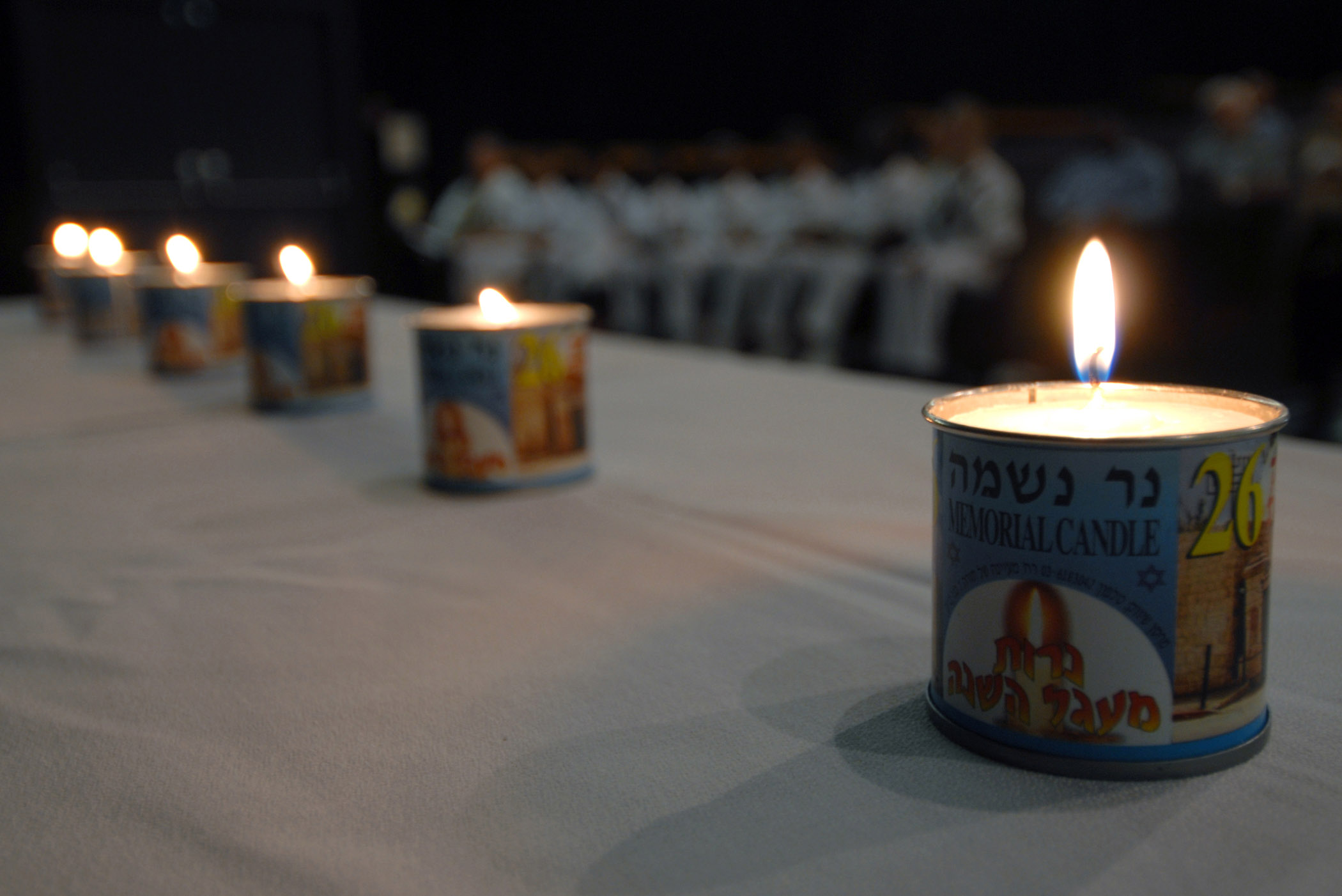
Lit Yahrzeit candles on Holocaust Remembrance Day. Photo: Wikimedia Commons.
This year, Holocaust Memorial Day (Yom Hashoah) finds Jews deeply worried.
Here in the United States, we’ve witnessed cemetery desecrations, little children evacuated from Jewish community centers, and a 45 percent spike in anti-Jewish incidents across America’s elite college campuses.
In England, we see too many Labourites injecting anti-Jewish animus into the political mainstream.
In France, we saw the far-right Marine Le Pen declare on national TV that France was not responsible for the Vél d’Hiv roundup in July 1942, when French police arrested more than 13,000 Jews, detained them for five days in Paris’ Vélodrome d’Hiver cycling stadium and then deported them to Auschwitz. We also saw a French judge refuse to issue hate crimes charges against criminals who admitted that they chanted antisemitic threats during their rape and rampage of a Jewish couple.
In 2017, we also saw — for the first time since 1945 — a Jewish institution forced to close because of overt Nazi threats. This took place in Sweden, where the JCC in Umea was closed after being desecrated with swastikas, and after Jews received threatening phone calls. A known neo-Nazi group, Nordfront, was reportedly behind the threats.
One Jewish parent lamented, “My mother and father are (Holocaust) survivors, so this is not OK. Enough is enough. It was like stepping into their shoes in the 1930s.”
And in Iran, the mullahocracy continues to deny the Holocaust, while parading ballistic missiles bearing threats to annihilate the Jewish State and fulfill Hitler’s vision.
Therefore, on this Yom Hashoah, perhaps Jews could be forgiven if they focused exclusively on take caring of their own.
But Rabbi Yisrael Meir Lau, the former chief rabbi of Israel, disagrees.
Rabbi Lau was an eight-year-old Shoah survivor when he reached Israel — just three months after World War II ended.
Seventy-two years later, he invokes the specter of the Holocaust to demand that Israel do more to help the people of Syria, which has often been an implacable enemy of the Jewish state.
“This is certainly a shoah of the Syrian people and it did not start today,” Rabbi Lau said. “For the past six years, they have been living in a Holocaust.”
Lau added that as “a nation that has suffered more than any other nation,” Israel must go in and help Syrian civilians, dozens of whom were recently killed in a chemical attack.
And Rabbi Lau is not alone: Israel’s Sephardic chief rabbi, Yitzhak Yosef, likewise called the war in Syria “a small Holocaust.”
“The people of Israel underwent a horrible Holocaust 70 years ago,” Yosef said. “Millions of Jews were murdered … and the world saw and remained silent; we as Jews who felt this silence in our own flesh cried out for years, we asked how the world knew and remained silent? … As Jews it is forbidden for us to remain silent. … Genocide cannot be ignored, not in Syria and not anywhere, and not against any people, even if they are not our friends.”
Why would Rabbi Lau invoke the Shoah?
First of all, because the images of those little children gassed to death just hundreds of miles from Tel Aviv rekindled in him the nightmares of an eight-year-old boy.
Of course, he knows from brutal experience that Ilbid and Auschwitz cannot be compared. The Nazi Holocaust was unique in the annals of all human history — in its scope, its barbarity and because it targeted for annihilation an “enemy” that posed no military threat nor controlled any territory. Six million Jews were hunted down, ghettoized, starved and mass murdered by the Nazis and their enthusiastic collaborators across Europe.
But I believe that Rabbi Lau used the Shoah imagery because he understood what the other goal of the Nazis was — not just killing Jewish lives, including his sainted rabbinic father, but annihilating Jewish Life.
Rabbi Lau’s call to action emphasizes a central Jewish value: “Lo taamod al dam réakha.” (Leviticus 19:16) — “Thou shall not stand idly by the shedding of the blood of thy fellow man.”
As the late Elie Wiesel explained: “The word is not ‘akhikha,’ thy Jewish brother, but ‘réakha,’ thy fellow human being, be he or she Jewish or not. All are entitled to live with dignity and hope. All are entitled to live without fear and pain.”
From the moment he arrived in Israel in 1945, Lau believed that each day that he lived in the Jewish state was another defeat for Nazism and all the contemporary genocide wannabes — from Iran and ISIS to Hezbollah and Hamas.
But Rabbi Lau also believes that for us Jews, survival — from Egypt to Auschwitz — has always been just the beginning. We have values to live up to — the very values that the Nazis sought to obliterate.
“Lo taamod al dam réakha” — “Do not stand idly by while others, even your enemies, bleed.”
The Torah teaches us that this is what separates civilized people from barbarity.
That too, is our challenge on this Yom Hashoah.
Rabbi Abraham Cooper is associate Dean of the Simon Wiesenthal Center in Los Angeles. Follow the Simon Wiesenthal Center on Facebook and on Twitter. This article was originally published by FOX News.