





Alleged Trump ‘Regime Change’ Policy Sparks Angry Denunciations of US From Iranian Leaders
Error: Contact form not found.

 by Ben Cohen


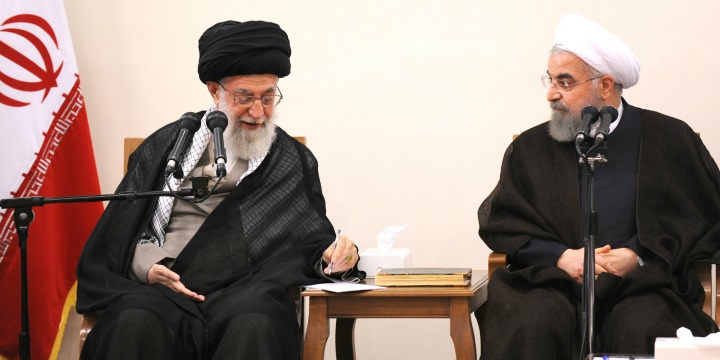
Iranian Supreme Leader Ayatollah Khamenei (left) with President Hasan Rouhani. Photo: Iranian official
Anxiety in Tehran over US President Donald Trump’s decision to actively side with rival Sunni Arab states in the ongoing Qatar crisis led on Sunday to fiercely anti-American statements from conservative and so-called “moderate” leaders alike, who believe that the administration’s behavior demonstrates a renewed American commitment to “regime change” in Iran.
Iranian President Hassan Rouhani – a vocal advocate of the 2015 nuclear deal agreed between Iran and six world powers – told a meeting organized as part of the Islamist regime’s “Judiciary Week” that “being revolutionary means isolating the United States.”
Claiming that the US had alienated the international community after the US Senate imposed tough new sanctions on Iran in June, Rouhani said the goal of Iranian foreign policy should be to “make powers condemn the US and reproach it should it choose to stand against us.”
At the same event, Ali Larijani – a conservative hardliner and Holocaust denier who currently serves as the speaker of Iran’s parliament – contrasted the current administration with the previous Obama Administration’s approach to Iran. “The Americans have been expressing their anti-Iran policies in a much more transparent way in recent months,” Larijani observed, adding that concerns about Iran’s missile program, its human rights record and its support for terrorism were simply “pretexts” for the US to pursue regime change in Iran.
Larijani also accused the US of violating its agreements under the nuclear deal, warning that a “strong response” from Iran should be expected.
Some analysts believe, however, that the Trump Administration’s aims are not as clear cut as Iranian leaders appear to think. In a recent policy paper for the Middle East Media Research Institute (MEMRI), analysts Yigal Carmon and A. Savyon asserted that the Trump Administration was pursuing an “incoherent” policy that had effectively consented to “Iran’s regional expansion.”
“Iran has pushed the US into a difficult dilemma: whether to become entangled in a war against Iran and against the resistance axis that is backed by Russia, or to continue negotiating with Iran, while coming to terms with the JCPOA and as Iran continues its violent expansion across the Middle East,” the analysts noted. “At this stage, the American administration is not willing to pay the price of changing the situation that it inherited from the previous administration, and it prefers to disregard not only Qatar’s role in encouraging Islamist radicalization and terrorism, but also the situation in Syria and Yemen, the fact that Iraq is an Iranian proxy, and Iran’s establishing itself as a global nuclear and missile power.”
The likely result, Carmon and Savyon argued, “Saudi Arabia and its allies in the Sunni world and Israel will have to bear the burden of confronting the Shi’ite-Iranian challenge in the region on their own.”
Carmon and Savyon claimed that “two political camps are discernible” within the US administration. “One is that of President Trump and his close advisors, who support Saudi Arabia and the Sunni axis, and the other is that of US Secretary of State Rex Tillerson and Secretary of Defense James Mattis, who are showing sympathy for Qatar and acting to preserve the pro-Iran status quo of the Obama era.”
Yet Tillerson’s own position is not entirely clear either. On June 14, Iran strongly condemned the secretary of state for suggesting that he was in favor of regime change, after he told a congressional committee that the US would support “those elements inside of Iran that would lead to a peaceful transition of that government.” Iranian foreign minister Javad Zarif accused Tillerson of “reverting” to an “unlawful and delusional regime change policy” in response.


