





As Israel Faces Growing Threat From Enemy Drones, Science Fiction Comes to Life
Error: Contact form not found.

 by Yaakov Lappin / JNS.org

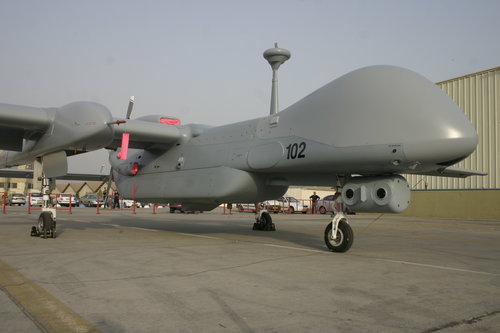
An Israeli-developed Heron TP drone. Photo: Tsahi Ben-Ami / Flash 90.
JNS.org – A quadcopter from the Gaza Strip landed in southern Israel earlier this month, and the IDF released a short message, saying that a unit had arrived to take the copter away. This seemingly mundane incident is, in fact, indicative of a growing trend: the use of drones by Israel’s enemies.
Hezbollah, Hamas, the Islamic State and other radical non-state actors now have their own drone programs, each at different stages of development, and posing different levels of threats.
Israel is a world pioneer in the use of military drones; the Jewish state was the first to utilize drones to coordinate strikes on the battlefield in the 1980s. Today, Israel is a global leader in drone technology — but Israel’s enemies have begun getting in on the act.
Tal Inbar, head of the Space and UAV Research Center at the Fisher Institute for Air and Space Strategic Studies in Herzliya, told JNS.org about two types of developing threats. The first is the enemy’s use of commercial drones, which Inbar said are “very good vehicles. They are accurate, and you can plan their flight paths. Controlling them is comfortable, and they can carry payloads.”
In Syria, the Islamic State has used commercial drones to drop a variety of explosives on targets, Inbar said. But even the mere presence of these drones can be utilized as a weapon.
“If they enter a protected area, they can disrupt something like air traffic. If you’re running Ben-Gurion International Airport, and suddenly you see two to three quadcopters landing, you wouldn’t be giving anyone permission to take off or land,” said Inbar.
The second category of threat is the larger fixed-wing unmanned aerial vehicles (UAVs), which are used by Hamas and Hezbollah. Hamas has its own fixed wing drone production program in Gaza, Inbar said, describing those aircraft as “relatively simple.” But Hamas is experimenting with placing weapons under the wings of these UAVs, he added.
Hezbollah, by contrast, imports industrially-produced, sophisticated Iranian-made military drones, which cost considerable money to develop. Hezbollah’s drones include guided rockets that can be launched at targets on the ground, a few miles away.
“The [drones] could, in principle, fly over Lebanon, and fire at targets in Israel,” Inbar said.
“Hamas is working on achieving that capability, too,” he added. “The Hamas drones have rockets, but they’re not yet guided. You don’t have to be a super engineer to improve these capabilities [though].”
Haim Haviv, head of the Integrated Electronic Warfare Systems for Mountains Terrain program at the Israeli defense company Elbit Systems, said, “We can say that capabilities once reserved for big organizations and militaries are now in the hands of smaller groups like Hamas, ISIS (Islamic State) and others.” These groups are using “high-performance commercial drones to gather intelligence and launch strikes at people and vehicles,” he told JNS.org.
A drone purchased on eBay can immediately be used to gather intelligence, delivering quality visual images from afar. Dropping bombs is more complex, but can be done with some relatively simple adaptations, Haviv said.
Elbit sells a defensive counter-measure to the threat of commercial drones, called ReDrone. ReDrone detects the presence of drones using a variety of sensors, and disrupts their communications and navigational systems, blocking radio signals and satellite transmissions that the drones need to know where to fly.
“The ReDrone system is already being sold. We are seeing a lot of interest in the solution we offer, and [we] are … continuing to develop these capabilities,” Haviv said.
Looking ahead, Haviv believes that commercial drones will become involved in a growing number of security incidents.
“The future battlefield is becoming increasingly complex,” Haviv said, noting that it will be filled with autonomous drones, some of which have the ability to fly like a flock of birds in formation.
To defend an area as large as a state, fighter jets and surface-to-air missiles are the tools to get the job done, said the UAV Research Center’s Inbar. Israel has used both to shoot down enemy drones that have intruded into its air space from Gaza and Lebanon in recent years.
Inbar issued a cautionary note about what could happen during a full-scale conflict, when Israel’s skies would be crowded with incoming rockets and Israeli air defense interceptors.
“During such times, the freedom to maneuver, and the ability to send an F-16 into the sky to shoot down a drone, won’t always be there,” he said.
The future will likely see terrorist entities develop heavier drones armed with higher-quality weapons, and — on Israel’s side — improved counter-measures, Inbar added.
One day, Inbar said, the sight of drones defending the skies against other drones may not be science fiction.
“Not only is that possible, it is desirable,” said Inbar. “Patrolling the skies is a boring mission. If you can assign a UAV to do that, and install a lot of ammunition on it, that would be a good thing.”


