




Despite Unwavering Support for Hamas, Qatar Seeking Improved Ties With ‘Jewish Community Worldwide’
Error: Contact form not found.

 by Ben Cohen



The Muslim Brotherhood axis: a poster in Gaza shows Qatar’s rulers alongside the leaders of Hamas and Turkey. Photo: Twitter.
The Gulf state of Qatar — long-shunned by the pro-Israel community in the US for its overt financial and political backing of the Palestinian terrorist group, Hamas — has announced a new public relations initiative to win hearts and minds among Jews in the US and abroad.
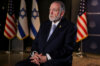
The Qatari effort is being represented by Nick Muzin, a former deputy chief of staff to Senator Ted Cruz (R-TX) and a familiar figure in pro-Israel circles. In a statement issued on Tuesday, Muzin said he believed that the Qataris were “sincere” in their desire to improve relations with “the US and the Jewish community worldwide.”
“We are setting certain goals and I expect to see meaningful progress,” Muzin said.
Given Qatar’s current low standing with other Gulf states as well as Israel, along with the emirate’s increasing embrace of the Islamist regime in Iran, polishing its image in front of both Jewish and many Arab audiences would seem to be an uphill task.
On Wednesday, Saudi Arabia accused Qatar of prolonging the four-month-old diplomatic deadlock over the emirate’s backing of terrorist groups. “I think the Qataris may be in denial because they talk about being blockaded and they forget the core issue, which is their support for terrorism,” Saudi Foreign Minister Adel al-Jubeir remarked during a visit to London.
Qatar has also attracted the wrath of other Middle Eastern states because of the slanted coverage broadcast by its news channel Al Jazeera, which is owned by the ruling al-Thani family. In July, Israeli Prime Minister Benjamin Netanyahu accused Al Jazeera of “inciting violence” by Palestinians on Jerusalem’s Temple Mount, while Israeli Defense Minister Avigdor Lieberman characterized the broadcaster as “not media, it is a propaganda outfit in the style of the Soviets or Nazi Germany.”
A particularly damning account of Qatar’s relationship with Hamas and other Islamist terror groups was presented to the House Foreign Affairs Committee at the end of July by Jonathan Schanzer, an expert on terrorism at the Foundation for the Defense of Democracies (FDD) think tank in Washington, DC.
“Our critique of Qatari foreign policy has been consistent,” Schanzer said. “We have pointed to Qatari support for Hamas, the Taliban, jihadists in Syria, jihadists in Libya and the Muslim Brotherhood.”
Currently the terror organization’s most important regional backer, Qatar has pledged at least $1.4 billion to Hamas-ruled Gaza since the 2014 war with Israel. A significant portion of Qatar’s funding has been used by Hamas to boost its military infrastructure, including the reconstruction of underground tunnels to launch terrorist attacks inside Israel.
In his testimony, Schanzer said the terrorist group’s “operatives work out of Qatar with impunity, where they fundraise and even plan terrorist attacks.” In one of several examples of the connections between Hamas terrorists and the Qatari authorities cited before the Foreign Affairs Committee, Schanzer noted the case of Husam Badran, a Hamas terrorist “responsible for taking dozens of Israeli lives.”
“[Badran] has been living in Qatar since 2011 after being released from Israeli prison,” Schanzer testified. “According to an Israeli Defense Forces website, Badran directed from Doha a 2013 Hamas plot to kidnap Israeli soldiers. He also was responsible for directing the activities and recruitment for a Hamas headquarters in the West Bank that was broken up in 2015, and for providing that network with hundreds of thousands of dollars from his perch in Qatar. He still appears to be residing in Qatar today.”
In the statement announcing that Qatar had retained his services, Muzin said he had held “early discussions” with his client on several topics, including “financial support of Hamas-controlled Gaza.”
The Algemeiner reached out to Muzin to inquire further into the content of these discussions and to ask whether he expected Qatar to announce any important shifts in policy, in advance of reaching out to Jewish leaders. Clarification was also sought as to why Muzin’s firm would represent a state that provides financial backing as well as sanctuary to Hamas terrorists.
While no response to these specific questions was received, Muzin answered The Algemeiner’s inquiry through a representative, who said in an email that no further comment would be forthcoming.


