





Several Hundred Syrian Refugees in Lebanon Return to Syria
Error: Contact form not found.

 by Reuters and Algemeiner Staff

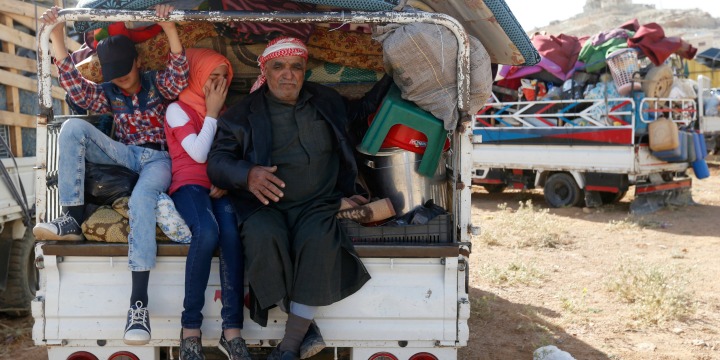
Syrian refugees prepare to return to Syria from the Lebanese border town of Arsal, June 28, 2018. Photo: Reuters / Mohamed Azakir.
Nearly 400 refugees began leaving the Lebanese border town of Arsal to cross into Syria on Thursday, a rare case of returns which Lebanon’s government wants to encourage.
The convoy made up a very small fraction of the one million registered Syrian war refugees across Lebanon — about a quarter of its population — and of the 50,000 which local officials estimate live in Arsal.
People gathered in minivans and tractors in the morning, loading them with mattresses, water tanks and furniture. Lebanese security personnel recorded the names of Syrians as they passed through a checkpoint on the way out of Arsal.
The refugees were headed for Qalamoun across the border, a region cleared of insurgents by Syrian army offensives in which Lebanon’s Iran-backed Hezbollah movement played a leading role.
Those leaving said they had submitted their names to Lebanese authorities, who in turn sent the names to Syria for approval from the state.
Syrian state TV said hundreds of people arrived past a border crossing in the Damascus countryside.
Many said they were happy to be returning to Syria, and while some said their houses were fit to live in, others had heard their homes were destroyed.
“We have been planning to go back for a long time; we are glad things have calmed down,” said Ali Abdullah, 34, leaving with his wife and two young sons. One of the boys was born in Lebanon and had never been to Syria.
“I want to take him back because that is your country, your (home is) not a tent,” Abdullah told his son. He spoke from the same truck he said he drove across the border in four years ago.
Abdullah told Reuters he had heard from relatives in Syria that his house there was fine.
But Murshid Darwish, 55, said she had decided to stay in her tent in Arsal instead of leaving for Syria with her cousin.
“The house needs work, there are no windows, no doors…We cannot live there,” she said. “I cannot carry rocks…Once my room is fixed, I will go back.”
The UN refugee agency UNHCR said it was not involved in organizing the returns, and its team in Syria had so far not been able to access the villages where people were headed.
‘First phase’
About 140 people received polio vaccines, and the Lebanese Red Cross diagnosed 43 people who received medication for acute cases, it said.
Major General Abbas Ibrahim, head of Lebanon’s General Security agency, has said Beirut is working with the Syrian state for the return of thousands of refugees who want to go home.
Ibrahim told Reuters Thursday’s return marked the “first phase out of thousands…We have not received any guarantee that they will not serve in the Syrian army. We have nothing to do with this.”
As Syrian troops and allied forces retake more territory, Lebanese officials have stepped up calls for refugees to go back to parts of Syria where violence has died down.
UN officials and foreign donor states have said it is not yet safe for refugees to go back to Syria, where a political deal to end the multi-sided war remains elusive.
The seven-year conflict has driven 11 million Syrians from their homes. More than 1 million have fled to Lebanon, the UN refugee agency UNHCR says. The Lebanese government puts the number at 1.5 million, a quarter of the population.
They are scattered across Lebanon, often in makeshift camps and severe poverty, facing the risk of arrest because of restrictions on legal residence and work.
Lebanese Foreign Minister Gebran Bassil visited Arsal this month to press for more returns. He froze residency visa applications for UNHCR staff, accusing the agency of preventing Syrian refugees from going back.
UNHCR denies this, saying it supports return when it is safe, and major international donors have voiced dismay at what they called “false accusations.”
“We are working in various ways for the gradual removal of the obstacles that refugees see to their return, including through advocating with the concerned authorities inside Syria,” UNHCR spokeswoman Lisa Abou Khaled told Reuters by email on Thursday.
“We fully respect individual decisions to return when a refugee decides that the time is ripe for him or her.”


