






Tehran Regime Official: US Trying to Make Iran ‘Surrender’ Through Sanctions
Error: Contact form not found.

 by Reuters and Algemeiner Staff

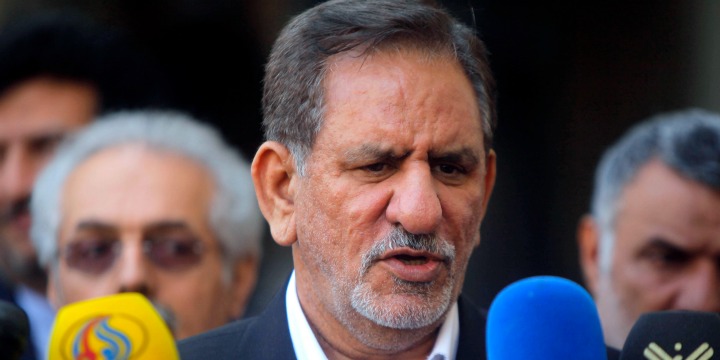
Iranian Vice President Eshaq Jahangiri speaks during a news conference after a meeting with Iraq’s top Shi’ite cleric Grand Ayatollah Ali al-Sistani in Najaf, south of Baghdad, Feb. 18, 2015. Photo: Reuters / Alaa Al-Marjani.
The United States is trying to make Iran surrender through the imposition of sanctions, Iranian Vice President Eshaq Jahangiri said on Wednesday.
New US sanctions against Iran took effect last week, and President Donald Trump said companies doing business with the country will be barred from the United States.
“The first priority for all of us under a sanctions situation is to work toward managing the country in a way that brings the least amount of damage to people’s lives,” Fars News quoted Jahangiri as saying. “America is trying by applying various pressures on our society to force us to retreat and surrender.”
The new sanctions targeted Iranian purchases of US dollars, metals trading, coal, industrial software and its auto sector, though the toughest measures targeting oil exports do not take effect for four more months.
Few US companies do much business in Iran so the impact of sanctions mainly stems from Washington’s ability to block European and Asian firms from trading there.
President Hassan Rouhani made similar comments to Jahangiri, although he did not specifically refer to the United States.
“We will not let the enemy bring us to our knees,” Rouhani said, according to state TV. “If the enemy thinks they will defeat us they will take this hope to the grave with them.”
Washington had said Iran’s only chance of avoiding the sanctions would be to accept an offer by Trump to negotiate a tougher nuclear deal than the international accord struck in 2015. Trump pulled the United States out of this agreement with world powers in May.
“America itself took actions which destroyed the conditions for negotiation,” Rouhani said, according to the Islamic Republic News Agency (IRNA). “There were conditions for negotiation and we were negotiating. They destroyed the bridge themselves,” he said. “If you’re telling the truth then come now and build the bridge again.”
Iranian officials have already rejected Trump’s offer and on Monday Ayatollah Ali Khamenei, the highest authority in the country, also ruled out the possibility of talks.
The Iranian economy is beset by high unemployment and a rial currency which has lost half its value since April. The reimposition of sanctions could also make the economic situation worse.
Rouhani said the economy is the biggest problem facing the country.
Thousands of Iranians have protested in recent weeks against sharp price rises of some food items, a lack of jobs, and state corruption. The protests over the cost of living have often turned into anti-government rallies.


