Terrorism Strikes Jordan
Error: Contact form not found.

 by Yoni Ben Menachem / JNS.org

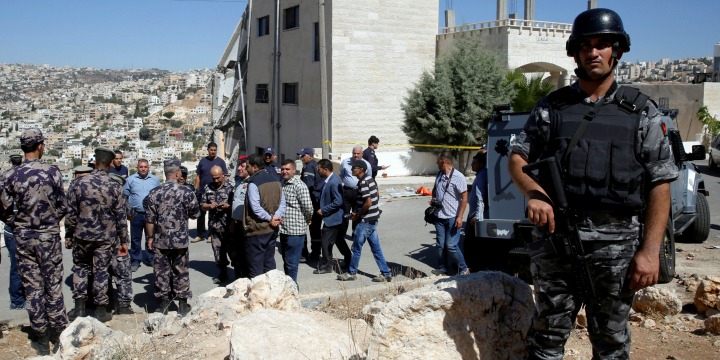
Security forces gather near a damaged building at the city of Salt, Jordan, August 12, 2018. Photo: REUTERS/Muhammad Hamed.
JNS.org – Over the past two years, Jordan has enjoyed relative quiet on the terror front. The last terror attack was at Karak Castle in southern Jordan in December 2016. In that incident, the terrorists attacked Jordanian police officers and barricaded themselves inside the Crusader castle, taking 14 hostages, including Malaysian tourists. Eventually, the terrorists were killed; a female tourist from Canada was also killed, along with nine other people, mostly members of the security forces.
It now appears that the terrorists are again cropping up in Jordan for a new wave of attacks on the security establishment, and their aim is to destabilize the Hashemite Kingdom. On August 11, an explosive device was planted in a Jordanian police vehicle in the town of Fuheis. The blast killed a policeman and wounded six others.
A quick investigation led to the terror gang’s hideout in a building in the city of Salt. The siege on the building lasted several hours. When the security forces tried to break into the building, the terrorists set off explosive devices that they had planted in advance; the building collapsed on the terrorists and security forces.
In this incident, five members of the security forces were killed, including Major Majad al-Huwaitat, commander of the special-operations unit. Another 20 people were wounded, and three terrorists were taken alive. The bodies of five other terrorists were found in the rubble of the building.
The investigation revealed that the terrorists were Jordanian citizens and not infiltrators from Syria or Iraq. The fact that this was a local terror infrastructure, heavily armed and operating professionally, is of great concern to Jordan’s ruling echelon.
Several days ago, the Chief of Staff, Field Marshal Mahmoud Freihat, said that Jordan “is still a target of attacks and its armed forces remain in high preparedness and alertness.” He was, however, addressing the danger of terror from Syria after the Syrian army’s takeover of the southern part of the country and deployment along the border with Jordan.
He did not anticipate that terror would strike Jordan from within using sleeper cells or lone wolves affiliated with radical jihadist Islam.
The investigation of the circumstances of the terror attack continues. The Jordanian security authorities assess that the terror infrastructure was independent but under Islamic State inspiration. To safeguard the investigation, they may not be revealing all the details to the public. The concern is that other sleeper cells exist that have yet to be identified.
Jordanian security forces are conducting a wide sweep among the younger generation of Salafi Jihadi activists in Salt, Zarqa, and Al-Rusaifa. The investigation has revealed that the leader of the terrorist cell was a wanted Salafi Jihadist, Ahmed Alnasur, who was apparently killed in the confrontation with Jordanian forces in the building in Salt.
King Abdullah warned that the terrorists are planning to attack “our children who serve in the military establishment and the security mechanisms.” By focusing on security personnel instead of civilians, the terrorists are trying to win the public’s sympathy, and sow discord between it and the ruling establishment.
King Abdullah called the terrorists “Khawarij,” meaning those who deviate from Islam, and promised that Jordan would settle accounts with whoever jeopardizes the security of the Hashemite kingdom and its citizens.
The terror attack in Fuheis and the clash with the terrorists in Salt sparked outrage in Jordan. Thousands of citizens came to the government hospital in Salt and asked to donate blood for the many wounded. Many Jordanians also condemned the terror attack on social networks. Former Prime Minister Abdullah Ensour proclaimed in a post: “Death to the murderers who spilled the blood of innocent people and took part in the attack in Fuheis.”
One possibility the security authorities are looking into is that the dormant terror infrastructure in the country was activated in response to the Islamic State’s defeat in Iraq and southern Syria. The presumed purpose was to show that the organization is still alive and well, even though it did not take official responsibility for the incidents in Fuheis and Salt. There may, however, be other explanations.
King Abdullah recently left the kingdom for 40 days, and upon returning said that he been busy recruiting investments and funds to bolster the country’s economy. From now on, it appears he will need to carefully consider his trips abroad in light of the deteriorating domestic security situation. It is believed that jihadist Islam still has not said its last word in Jordan.
Yoni Ben Menachem, a veteran Arab affairs and diplomatic commentator for Israel radio and television, is a senior Middle East analyst for the Jerusalem Center. He served as Director General and Chief Editor of the Israel Broadcasting Authority.