





‘If the IDF Won’t Deal With the Terror Threat, We Will,’ Says Residents in Israel’s North
Error: Contact form not found.

 by Israel Hayom / JNS.org

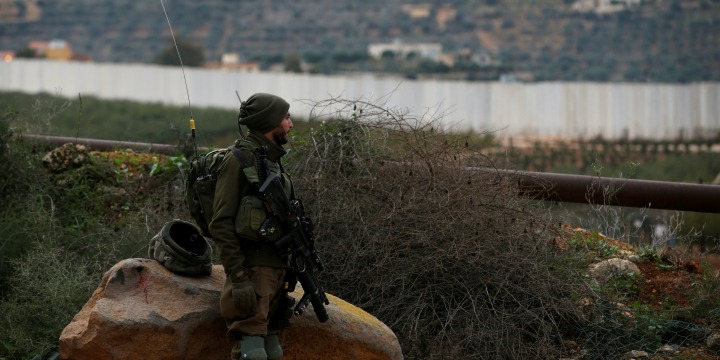
An Israeli soldier stands near the border with Lebanon, Dec. 5, 2018. Photo: Reuters / Ronen Zvulun / File.
JNS.org – The announcement by Israel Defense Forces on Sunday that “Operation Northern Shield” along Israel’s border with Lebanon had come to a close sparked mixed feelings among local residents.
The operation, launched Dec. 4, sought to expose and neutralize cross-border terror tunnels dug by Hezbollah under the Israel-Lebanon security fence.
Meir Biton of Moshav Avivim said that over the past six months, he had witnessed and recorded excavations of a shaft inside Lebanese territory.
“When I heard the operation had started, I was glad. They said they had found tunnels in Metula, in [Moshav] Zarit, in [Moshav] Shtula. And we thought they would also come to us, but they haven’t even come to check. Now it’s really scary. If they would at least look, then during wartime, I would stay home. But now that I heard they finished the operation, I know I won’t stick around for a second,” said Biton.
Nor were the fears of the residents of Rosh Hanikra allayed by the announcement that the operation had ended.
In recent weeks, residents have been speaking out to say they, too, have heard digging sounds over the past two years.
“The military was supposed to meet with residents, but every time the meeting was postponed, and it [a meeting] hasn’t been held to this day,” said Rosh Hanikra resident Gadi Shabtai.
Two weeks ago, a few boulders rolled down a moderate incline near a road that passes through the northern end of the newer neighborhoods of the kibbutz.
According to Shabtai, the rockfall raised residents’ suspicions because the weather had been calm. On Sunday, they decided to take matters into their own hands and rented an excavator to examine the site where the boulder had come loose.
“We carried out preliminary tests, and we were shocked to discover that the boulder was brittle. We were always told that the earth here is rocky and almost impossible to dig through, and therefore digging could be carried out at a pace of a meter [yard] a day, but this morning we realized this was nonsense. The excavator we brought in—just a simple mechanical tool—managed to dig through five meters in just half an hour,” said Shabtai.
“We aren’t ruling out the possibility of doing what they did in Moshav Zarit in 2015 and turning to private companies to help us. In my opinion, the tunnels the IDF found were a distraction, and there are much deeper tunnels that penetrate deep into Israel.”
Shabtai said that “if the army won’t do it, we, the residents, will.”
In a statement, the IDF said that all queries on the issue of tunnels had been “thoroughly examined and taken very seriously.”