




Hebrew as the Proof of Jewish Continuity
Error: Contact form not found.

 by Jacob Sivak

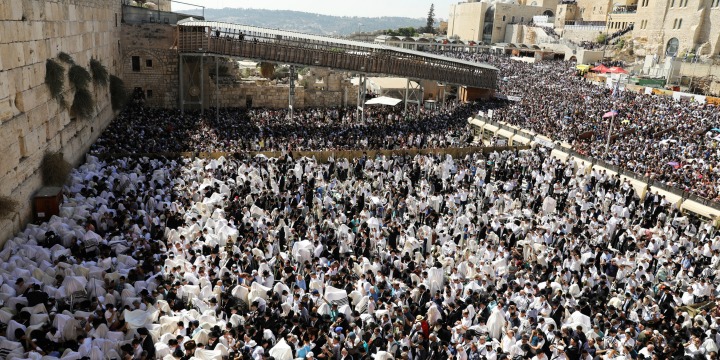
A general view shows thousands of Jewish worshippers attending the priestly blessing on the Jewish holiday of Sukkot at the Western Wall in Jerusalem’s Old City September 26, 2018. Photo: REUTERS/Ammar Awad.
Many have wondered about the underlying basis for the continuing existence of the Jewish people. In their book Jews and Words (2012), Amos Oz and his daughter Fania Oz-Sulzberger point out that Jewish continuity has always depended on spoken and written words — “ours is not a bloodline but a textline.” More specifically, they draw a connection between Jewish continuity and the ancient and modern use of the Hebrew language.
The worldwide study of Daf Yomi is an example of the connection between Jews and words. On January 1, 2020, many news outlets reported on the 13th Siyum HaShas (completion of the Talmud). This event marks the end of the sequential one page per day (Daf Yomi) study of the 2,711 pages of the Babylonian Talmud. Initiated in 1923 by Rabbi Meir Shapiro of Poland, each participant studies the same page each day. The end of the 13th cycle involved 350,000 participants, the vast majority Orthodox Jews.
Project 929, which was initiated in Israel in 2014, uses the same model to encourage the study of the Hebrew Bible (the name comes from the 929 chapters of the Bible, the Tanach). Participants study five chapters per week. According to one source, there were 250,000 participants in the first cycle, three quarters of them secular. As for Talmud study, those involved can use non-Hebrew translations, but Hebrew (and Aramaic in the case of the Talmud), as the source language, is the final word.
In fact, in Hebrew Roots, Jewish Routes, A Tribal Language in a Global World (2019), Jeremy Benstein emphasizes that throughout most of their history, Jews have been multilingual, often using a Jewish language such as Yiddish or Ladino for use in the home and the street, while Hebrew remained a liturgical language that was also used for study. Alternatively, or additionally, languages such as Greek, Aramaic, Arabic, and English have also been used as the vernacular tongue.
Benstein provides a wonderful description of the Hebrew language, emphasizing its compact vocabulary and system of three consonant roots with interconnected layers. He describes the use of Hebrew in traditional as well as modern Jewish life, as well as the relation between Hebrew and the Hebrew calendar, including the annual cycle of Jewish holidays.
He asks whether historical religious Hebrew and contemporary Israeli Hebrew are one language or two, noting that while 61 percent of the underlying roots of Hebrew are Biblical in origin, only 21 percent of contemporary dictionary entries are Biblical. However, a language is really defined by political and social considerations, not only grammar, and multiple language dialects are common for other languages too.
As to whether ancient and modern Hebrew are one language, Benstein believes they are. He quotes the American writer Cynthia Ozick as saying, “Hebrew as a contemporary language … is no longer the language of the Bible; but neither is it not the language of the Bible.”
In Jews and Words, Oz and Fania Oz-Sulzberger state that the revival of Hebrew (there are an estimated nine million Hebrew speakers worldwide) is the most creative and least controversial accomplishment of the modern Zionist movement. While I can agree that it is the most creative feature of modern Zionism, I am not so sure about the claim to being non-controversial.
A 2019 resolution of the Anglican Church of Southern Africa titled “Time to act: Solidarity with Palestine” includes an effort to disconnect Jews from Israel, and Zionism from Judaism. Moreover, in 2018, the JTA reported that in a speech to a meeting of the Palestine Liberation Organization’s Central Council, Palestinian President Mahmoud Abbas denied a Jewish connection to Israel saying: “Israel is a colonial project that has nothing to do with Jews.”
In the struggle between rival Israeli and Palestinian narratives, the question of who has indigenous status has come up. The UN bases indigeneity on a number of factors, including a distinct language, culture, and religion. No doubt, the long and continuing role of the Hebrew language in Jewish life will play an important part in this controversy.
Jacob (Jake) Sivak, elected a Fellow of the Royal Society of Canada in 2002, is a retired professor in the School of Optometry, University of Waterloo, where he continues his research interests as a Distinguished Professor Emeritus. He has a lifelong interest in the history of the Jewish people.