








Coronavirus, Blacks, and Black-Hats — a Classic New York Times Double Standard
Error: Contact form not found.

 by Ira Stoll

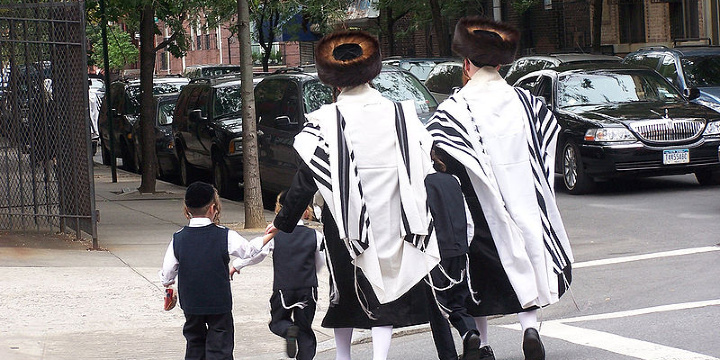
Ultra-Orthodox Jews. Photo: Wikicommons.
Let’s take a look at a side-by-side comparison of two New York Times news articles about communities hard-hit by the novel coronavirus.
The first example blames the victims for “failing to comply with government restrictions.” It paraphrases “experts” who claim that the “proliferation” is the result of “overcrowding and large families, deep distrust of state authority, ignorance of the health risks … and a zealous devotion to a way of life centered on communal activity.” Ignorant zealots disobeying the rules, got that?
The second example blames society, alleging that the disproportionate infection rate highlights “what public health researchers say are entrenched inequalities in resources, health and access to care.” In this case, the Times “experts” — what would the Times do without the journalistic convention of using “experts” to convey the opinions of editors? — say that “the reasons behind the disparities are not difficult to explain, the result of longstanding structural inequalities.” These “structural inequalities” include that the group is “more likely to have existing health conditions” and to face “bias that prevents them from getting proper treatment.”
The first example is Orthodox Jews in Bnei Brak, Israel. The second example is black Americans in the United States.
It’s a classic New York Times double standard. Neither treatment is particularly friendly — describing black Americans as victims of bias and structural inequality deprives them of agency — but at least the black Americans aren’t getting blamed by the Times for their own suffering, or getting insulted as ignorant zealots.
Actually, while the Times subheadline claims “failure to comply with government restrictions is causing the coronavirus to spread in ultra-Orthodox communities,” the photographs accompanying the article show Jews wearing masks and standing or sitting outdoors and at a distance from one another.
As is often the case with Times coverage of Israel, this article features a correction appended: “Correction: March 31, 2020 An earlier version of this article referred incorrectly to the Israeli government’s restrictions on prayer in response to the coronavirus. Prayer outdoors in groups of up to 10 people was permitted by the government until Monday night.” The Times headline, in other words, was criticizing Jews for their supposed “failure to comply” with restrictions that were not even in place at the time the headline was reported.
The Times depicts Bnei Brak as some kind of anarchist backwater. Actually, the local government there has a lot of trust, the result of a unique and innovative power-sharing agreement in which the mayoralty rotates in turn between chasidic and yeshivish or “Lithuanian” leaders. Moshe Freidman, who works to integrate religious workers in the Israeli high-tech industry, lives there.
The Times reports, “In the Tel Aviv suburb of Bnei Brak, where 95 percent of the residents are ultra-Orthodox, the number of confirmed cases spiked from 267 on Friday to 571 on Tuesday. The total was nearly that of Jerusalem, whose population is four times bigger.” The Times news columns insist in describing them as “ultra-Orthodox,” despite the fact that the Times itself recently published an op-ed article by Avi Shafran accurately reporting that this population does not want to be called by that name. There are lots and lots of traditionally observant Jews in Jerusalem too. The disparity suggests that the spread of the virus may have less to do with the supposed ignorant zealotry of Orthodox Jews and more to do with the mechanism of the way the disease spreads, from one person who has it to another.
There is also a hotel in Tel Aviv full of apparently non-Orthodox Israeli coronavirus patients, but that hasn’t been a story for the Times. The newspaper prefers to portray Covid-19 as a disease that affects ignorant zealots who disobey the rules — at least if those who test positive are Israeli Jews, rather than American blacks.
Ira Stoll was managing editor of The Forward and North American editor of The Jerusalem Post. His media critique, a regular Algemeiner feature, can be found here.