






Iran’s Guardian Council Approves Law on Hardening Nuclear Stance, Halting UN Inspections
Error: Contact form not found.

 by Reuters and Algemeiner Staff

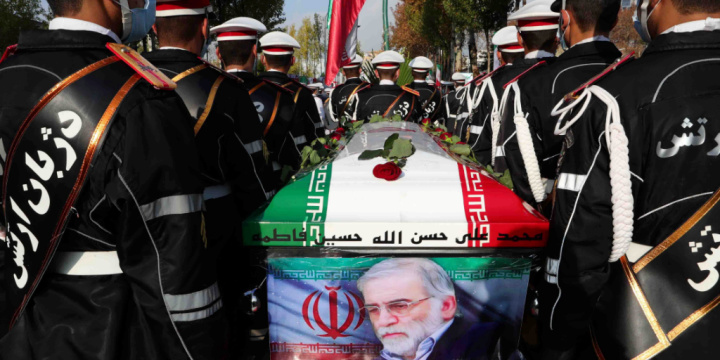
The coffin of Iranian nuclear scientist Mohsen Fakhrizadeh is seen during a funeral ceremony in Tehran, Iran, Nov. 30, 2020. Photo: Iranian Defense Ministry / WANA (West Asia News Agency) / Handout via Reuters.
Iran‘s Guardian Council watchdog body approved a law on Wednesday that obliges the government to halt UN inspections of its nuclear sites and step up uranium enrichment beyond the limit set under Tehran’s 2015 nuclear deal if sanctions are not eased in two months.
In retaliation for the killing last week of Iran‘s top nuclear scientist, which Tehran has blamed on Israel, Iran‘s hardline-dominated parliament on Tuesday approved the bill with a strong majority that will harden Iran‘s nuclear stance.
The Guardian Council is charged with ensuring draft laws do not contradict Shi’ite Islamic laws or Iran’s constitution. However, the stance of Supreme Leader Ayatollah Ali Khamenei, who has the last word on all matters of state, is not known.
“Today in a letter, the parliament speaker officially asked the president to implement the new law,” Iran‘s semi-official Fars news agency reported.
Under the new law, Tehran would give two months to the deal’s European parties to ease sanctions on Iran‘s oil and financial sectors, imposed after Washington quit the pact between Tehran and six powers in 2018.
In reaction to US President Donald Trump’s “maximum pressure” policy on Tehran, Iran has gradually reduced its compliance with the deal.
The law pushed by hardline lawmakers would make it harder for US President-elect Joe Biden, who will take office on Jan. 20, to rejoin the agreement.
Biden has said he would return to the pact and would lift sanctions if Tehran returned to “strict compliance with the nuclear deal.”
“There’s now more pressure on (President Hassan) Rouhani’s government to secure a US return to the JCPOA (the Joint Comprehensive Plan of Action) quickly,” tweeted Ariane Tabatabai, a Middle East researcher at the German Marshall Fund and Columbia University.
Rouhani, the Iranian architect of the 2015 deal, criticized parliament’s move as “harmful to diplomatic efforts” aimed at easing US sanctions.
Under the new law, the government should resume uranium enrichment to 20% and install advanced centrifuges at its Natanz and Fordow nuclear facilities.
The deal caps the fissile purity to which Iran can refine uranium at 3.67%, far below the 20% achieved before the deal and below the weapons-grade level of 90%. Iran breached the 3.67% cap in July 2019 and the enrichment level has remained steady at up to 4.5% since then.
Britain, France and Germany, all parties to the 2015 deal, have urged Iran to fully respect it.


