





British Author Refuses to Include ‘Antisemitic’ ‘Merchant of Venice’ in Children’s Retelling of Shakespeare’s Plays

 by Shiryn Ghermezian


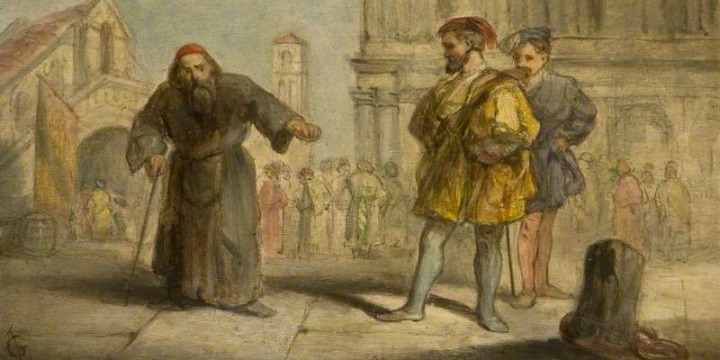
A scene from Shakespeare’s “The Merchant Of Venice” from the Birmingham Museums Trust. Photo: Wikimedia Commons.
A prominent British children’s author and playwright has decided to omit The Merchant of Venice from a young adult book he is working on, based on Shakespeare’s plays, because of its “antisemitic” nature.
Sir Michael Morpurgo, 77, is writing a book titled Tales from Shakespeare, a retelling of Shakespeare’s most popular plays that will be catered to a young demographic. The book, which is set to be published next year, will include Hamlet, The Tempest, A Midsummer Night’s Dream, Romeo and Juliet, Macbeth and King Lear. After rereading The Merchant of Venice, Morpurgo felt that he could not “honestly” retell it and thought it was “too raw to write about for children,” he told The Times in an interview published Sunday.
The main antagonist in The Merchant of Venice is Shylock, a Jewish moneylender who gives the character Antonio a loan on the condition that he can cut off a pound of Antonio’s flesh if he defaults. The play ends with Shylock — who is spat upon and insulted by Christian enemies — being ordered to convert. His daughter also runs away with a Christian and abandons her Jewish heritage.
“I did not tackle Shylock. I avoided [the play] because it worried me too much,” Morpurgo said. “There are assumptions right the way through about what it is to be a Jew and how Jews are thought of.”
“I did feel this was Shakespeare’s play and I could not tell it honestly,” he continued. “It would be offensive.”
The Merchant of Venice was a popular production in Nazi Germany, according to scholars, because Shylock’s characterization as a greedy Jew was in line with the antisemitic propaganda of the Third Reich. The play was performed in the theaters of the Third Reich “repeatedly,” according to British novelist Howard Jacobson, who added that “in Shylock, the Nazis saw the Jew they wanted to see.”
“Hitler’s willing directors rarely failed to exploit the antisemitic possibilities of the play,” wrote Kevin Madigan, professor of Christian history at Harvard Divinity School.
Literary critic Harold Bloom wrote in his 1998 book Shakespeare and the Invention of the Human that “One would have to be blind, deaf and dumb not to recognize that Shakespeare’s grand, equivocal comedy The Merchant of Venice is nevertheless a profoundly antisemitic work.”