



Frequent New York Times Opinion Writer Was Secret Iranian Agent, Federal Prosecutors Charge
Error: Contact form not found.

 by Ira Stoll

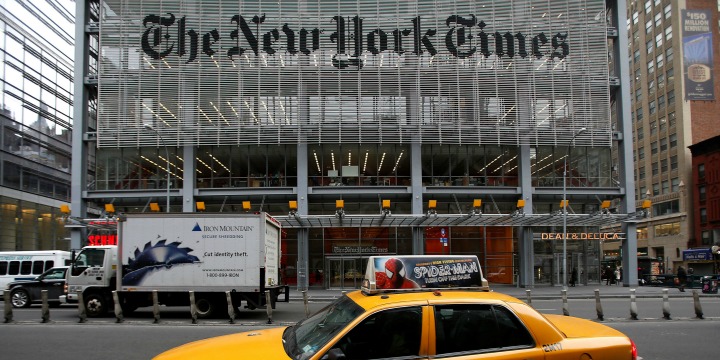
A taxi passes by in front of The New York Times head office, Feb. 7, 2013. Photo: Reuters / Carlo Allegri / File.
The New York Times published more than a dozen opinion articles and letters to the editor by Kaveh Afrasiabi. A 2018 Times op-ed under his byline identified him as “a former adviser to Iran’s nuclear negotiation team.” A 2012 Times op-ed identified him as “a former political science professor at Tehran University and former adviser to Iran’s nuclear negotiation team.”
This week, Afrasiabi was arrested and charged with acting as an unregistered foreign agent of the Iranian government.
A press release from the Department of Justice announcing the unsealing of a criminal complaint in the case says, “Since at least 2007 to the present, Afrasiabi has also been secretly employed by the Iranian government and paid by Iranian diplomats assigned to the Permanent Mission of the Islamic Republic of Iran to the United Nations in New York City (IMUN). Afrasiabi has been paid approximately $265,000 in checks drawn on the IMUN’s official bank accounts since 2007 and has received health insurance through the IMUN’s employee health benefit plans since at least 2011.”
The press release said that while employed by the Iranian UN mission, Afrasiabi “authored articles and opinion pieces espousing the Iranian government’s position.”
A criminal complaint and affidavit filed in federal court in the case says Afrasiabi was born in Iran in 1957 and entered the US in 1973. The complaint says the opinion pieces were authored “at the direction and under control of” the government of Iran. The complaint reports Afrasiabi emailing congressional staffers with hyperlinks to his New York Times opinion articles. According to the complaint, “In that article, AFRASIABI argued that the US sanctions on Iran acted as a major stumbling block in nuclear negotiations ‘since Iranian negotiators need[ed] to produce a tangible trade-off between any concessions and a recognition of Iran’s right to legitimate [nuclear] enrichment.’”
The complaint reports that on November 14, 2012, Afrasiabi emailed the counselor at the Iranian mission at the UN, complaining that “[US] government is in the palms of zionists so I focus on how we can best fight back.”
The complaint also says Afrasiabi helped the Iranian foreign minister with a draft of an op-ed that was eventually published in April 2015 in the New York Times. In a July 2020 email to the foreign minister, Afrasiabi cited his “hundreds of articles in international newspapers and academic journals,” explaining, “without support none of this would have been possible.”
Perhaps if Afrasiabi had been more transparent about his Iranian government connections, he might have been even more successful in getting published by the New York Times. The Iranian foreign minister, Javad Zarif, had a byline on at least seven Times op-ed pieces between 2003 and 2017, four of them between 2015 and 2017, prompting at least some wry speculation that the Times editors will give the Iranian diplomat a Peter Beinart-style promotion to “contributing opinion writer” status.
A hearing in the case is reportedly scheduled for Friday. Afrasiabi did not enter a plea in a brief court appearance Tuesday, according to press reports.
Ira Stoll was managing editor of the Forward and North American editor of the Jerusalem Post. His media critique, a regular Algemeiner feature, can be found here.


