






German Jews Angry at Prosecutor’s Decision Not to Charge Hamburg Synagogue Attacker Because of ‘Mental Illness’
Error: Contact form not found.

 by Algemeiner Staff

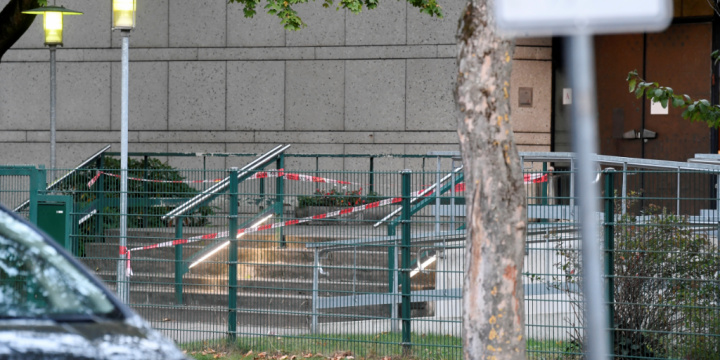
The staircase where a Jewish man was attacked is marked with barricade tape, in front of a synagogue, Hamburg, Germany, Oct. 4, 2020. Photo: Reuters / Fabian Bimmer.
The Jewish community in the German city of Hamburg expressed outrage this week in the wake of a public prosecutor’s decision not to prosecute the assailant in an attack on a synagogue because of alleged mental illness.
The attack occurred on Oct. 4th, 2020. A 26-year-old man who arrived at the Hohe Weide Synagogue for services celebrating the holiday of Sukkot was brutally beaten by the assailant, who wore military fatigues and was wielding a foldable shovel.
The assailant — identified as 29-year-old ‘Grigory K’ — was said to have been in an “extremely confused” state when he was apprehended by police.
At the start of his trial, the assailant was reported to have been calm. His victim, who is still suffering from injuries sustained in the assault, gave testimony.
However, the public prosecutor “is convinced that the assailant is said to have acted in a state of incapacity,” the Germany Jewish newspaper Juedische Allgemeine reported. An expert attested that the alleged perpetrator had acute paranoid schizophrenia, accompanied by delusional fears of persecution that triggered the offense. The expert sees “no evidence” that “the accused pursued religious, ideological, right-wing extremist or antisemitic goals with [his] free will.”
This assessment flew in the face of the Jewish community’s assessment of the attack, who saw it as unabashedly antisemitic — as did a number of leading German politicians. After the attack, for example, Foreign Minister Heiko Maas denounced it as “disgusting antisemitism” and warning that it could not be regarded as an “isolated incident.”
Hamburg’s Jewish community responded angrily to the prosecutor’s announcement.
“It must be recognized that the Jewish community was targeted,” said Philipp Stricharz, the community’s president.
“How can antisemitic acts be prevented in the future if they aren’t identified as such?” he asked.
Germany registered another spike in the number of antisemitic hate crimes committed during 2020, with conspiracy theories about the COVID-19 pandemic spurring much of the venom directed at the Jewish community.
According to German federal government figures released this month, at least 2,275 crimes with an antisemitic background were logged over a 12-month period ending in January 2021. Some 55 of those outrages were acts of violence.


