

Prisoner Exchanges Have Destroyed Israeli Deterrence
Error: Contact form not found.

 by Nan Jacques Zilberdik

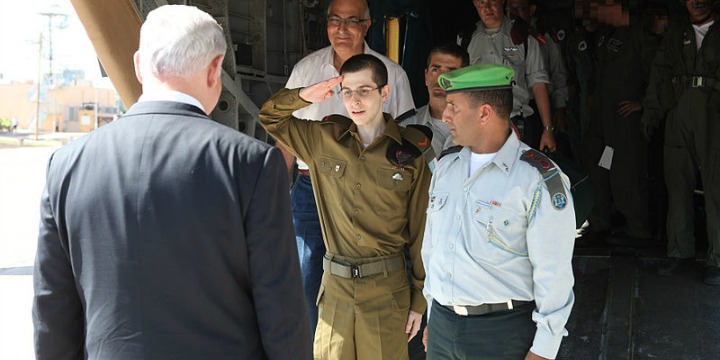
Gilad Shalit salutes Israeli Prime Minister Benjamin Netanyahu after prisoner exchange deal in Oct. 2011. Photo: Wikimedia Commons.
A Palestinian accused of aiding the six terrorist prisoners who recently escaped from an Israeli prison (and were subsequently re-arrested), expressed a common Palestinian conception of Israeli weakness. He, like other Palestinians, no longer thinks that the length of Israeli prison sentence is to be feared — because Israel will give in to demands to free terrorist prisoners prematurely in exchange for the release of Israeli hostages.
Accordingly, Iyad Jaradat, the Palestinian accused of aiding the terrorist fugitives, stated: “This [escape] is the first victory! The second victory [will be] a prisoners and missing persons [exchange] deal soon by our brothers from the Izz A-Din Al-Qassam Brigades [i.e., Hamas’ military wing], God willing. Soon we will come out [of prison], God willing.”
Official Palestinian Authority (PA) TV helps facilitate this belief, by broadcasting interviews with terrorist prisoners who were released early through exchange deals. Both potential terrorists and imprisoned terrorists — who watch PA TV in prison — are thus told that Israeli prison sentences should not be taken seriously, nor deter anyone from carrying out terror attacks.
The premature release of one murderer in the Gilad Shalit prisoner exchange deal — which saw 1,027 prisoners and terrorists released — was described on PA TV as “a message of hope” for all the imprisoned terrorists.
Abd Al-Hadi Ghneim was serving 16 life sentences for murdering 16 Israeli bus passengers in 1989, when he attacked the driver and forced the bus off a cliff. But instead of spending the rest of his days in a prison cell, Ghneim showed up on PA TV having been released prematurely in the Shalit deal in 2011.
Murderer Ghneim himself expressed his belief that imprisoned terrorists who are serving “heavy and long sentences” like he did, will be released in a similar way. He and other terrorists who were released early appeared on PA TV together with their relatives, exemplifying the message that “all the prisoners will be with us, and they will have a family with children,” as one Fatah official from Gaza put it.
Relatives of terrorist prisoners are convinced that their imprisoned family members will be released before they have served their sentences thanks to prisoner exchanges. Talking to his imprisoned nephew via official PA TV, an uncle assured the nephew of an early release: “Many were sentenced to life, sentenced to 25 years, and they got out via prisoner exchanges. Allah willing, you’ll get out.”
The PA is telling its people that terrorists serving life sentences should not believe that their sentences will be upheld, but rather expect to be released early. Furthermore, they’re saying that Palestinians who are considering or already planning attacks should not fear any sentence, because such sentences never turn out as harsh as they are given.
On the recent 10-year anniversary of the Shalit exchange, Palestinian Media Watch (PMW) exposed that Information Office Director Daoud Shihab from the terror organization Palestinian Islamic Jihad, likewise expects that terrorist prisoners will be exchanged in the future for Israeli hostages Avraham Mengistu and Hisham Al-Sayed, and the bodies of soldiers Oron Shaul and Hadar Goldin held in Gaza, like Shalit: “The Palestinian resistance in the Gaza Strip is still holding a number of Zionist prisoners and soldiers’ [bodies] today. This is good news for all our people… and all the heroes inside the occupation prisons, because freedom is coming.”
But it is not just Palestinian terror organizations that appreciate kidnappings and prisoner exchanges. PMW has documented that senior PA and Fatah officials — considered by many to be peace-seeking moderates — support kidnappings. Senior PA official and Deputy-Secretary of Fatah’s Central Committee Jibril Rajoub, for example, has encouraged more Hamas kidnappings like that of Shalit: “If Hamas wants to kidnap soldiers, let them kidnap soldiers. Let them kidnap. … The Israelis need to understand. It’s clear that kidnapping is the language they understand.” Rajoub even stressed that the PA and Fatah “encourage” Hamas, and “congratulated” them when they kidnapped Shalit.
It is clear that Israel’s willingness to agree to prisoner exchanges encourages more Palestinians to carry out terror attacks, as the threat of prison has been undermined as a deterrent.
The author is a senior analyst at Palestinian Media Watch.