









My Grandmother Survived Auschwitz; Here’s What Whoopi Goldberg Got Wrong
Error: Contact form not found.

 by Farah Kraus

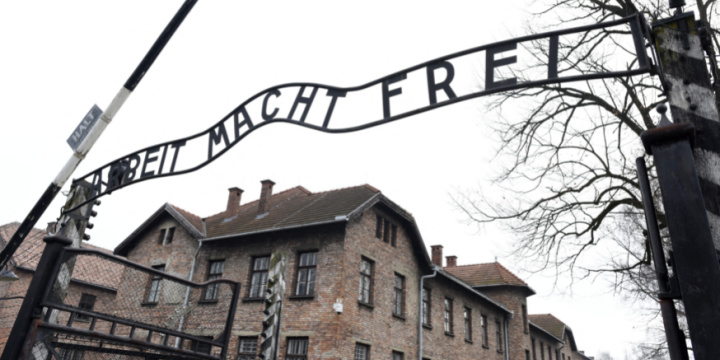
The sign “Arbeit macht frei” (Work makes you free) is pictured at the main gate of the former German Nazi concentration and extermination camp Auschwitz in Oswiecim January 19, 2015. REUTERS/Pawel Ulatowski
I do not believe that Whoopi Goldberg is antisemitic. But I do believe her words were wrong, and the derivative of an antisemitic framework that assumes Jews are “white” — and therefore, more likely to be the oppressor than the oppressed.
Given the size of Goldberg’s audience — and the many who share her views — her perspective is very concerning, because it will lead more people to view Jews and the Holocaust through her erroneous lens.
Most of the public conversation I’ve seen has been about whether the Holocaust was about race (it was). But I’ve been more worried about Goldberg saying that the Holocaust was about two “white” groups of people fighting each other — first on “The View” and then again on “The Late Show with Stephen Colbert.” Goldberg ascribed a 21st century (and erroneously interpreted) American lens to the Holocaust. That incorrect view erases my family history, and misidentifies the crystal clear motivation behind the Holocaust.
My grandparents were not “white” Polish people who fought “white” German people and lost. My grandparents were targeted because they were Jews; not because they lit Shabbat candles, but because they were ethnically, and in Nazi terminology racially, Jewish. Hitler didn’t randomly select Jews, among others, as his scapegoats. He tapped into centuries’ old antisemitic beliefs held by many in Europe at the time, and increasingly today.
After surviving Auschwitz and Ravensbruk, my grandmother tried to go back to her hometown. She was the only Jewish survivor, and was still told that if she entered, she’d be killed.
My great uncle was shot in the streets of Poland after being liberated from concentration camps. My parents have had antisemitic words spray-painted on their mailbox in suburban New Jersey. Antisemitism didn’t end with the Holocaust, and you don’t need to be a Nazi to say antisemitic things.
Many adult Jews living in the United States personally know a relative that was either a Holocaust survivor, or a refugee from a country they were lucky to escape from before being killed. The fact that Jews have reached a level of perceived success doesn’t erase the legacy of persecution that many of us carry, or the threats we face today.
Assuming all Jews are just “white” also shows a total ignorance about the diversity of Jewish people, which includes Jews of all colors — both in America and around the world. In Israel, for example, more than half the Jewish population is not of “white” European heritage.
When it comes to America, antisemitism from the right is rooted in telling me that I’m not white. Antisemitism from the left says I’m a white colonizer. Neither fit my identity, and I know I’m only one of many American Jews who struggle with this.
Over the past 11 years, I have visited more than 60 school classrooms, through 3GNY’s WEDU program, to share my grandmother’s story. I make sure that students understand that my grandmother’s family led a rich Jewish life before the Holocaust, but that antisemitism was always present. I’ve received hundreds of letters from the students I’ve spoken with, and it’s uplifting to read that the students plan to share her story with others, to stand up against hate and bigotry, and to learn more about the Holocaust.
Goldberg’s misguided interpretation of history should be used as a teachable moment. My hope is that those who heard her words will also take the time to learn why those words were viewed so hurtfully by many. More people need to understand what actually led to the Holocaust, so that we can address antisemitism and other forms of bigotry today.


