

California AG Urges Court to Return Nazi-Looted Painting to Heirs of Jewish Holocaust Survivor

 by Shiryn Ghermezian


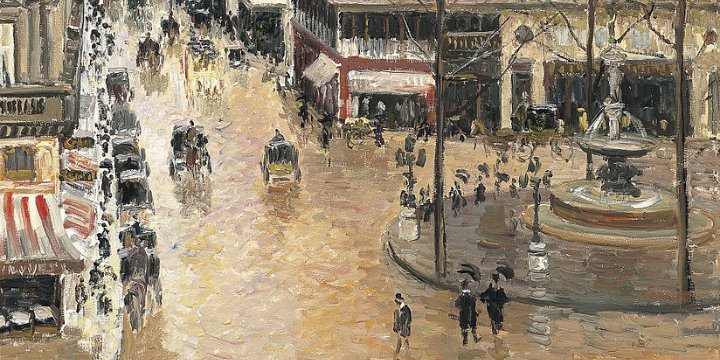
Detail of the painting “Rue Saint-Honoré in the Afternoon. Effect of Rain” by Camille Pissarro. Photo: public domain
California Attorney General Rob Bonta filed a legal brief last week calling on the US Court of Appeals for the Ninth Circuit to reverse a lower court’s ruling that has prevented a Jewish family from recouping a painting stolen from them by Nazis during the Holocaust.
The 1897 oil painting by Jewish-French impressionist Camille Pissarro — titled “Rue Saint-Honoré in the Afternoon. Effect of Rain” — is currently on display at the Thyssen-Bornemisza Museum in Madrid, Spain. It was originally owned by Holocaust survivor Lilly Cassirer Neubauer, who was forced to sell it to a Nazi art appraiser in order to obtain exit visas for her and her husband to flee Germany in 1939.
In a July 6 amicus brief filed with the appeals court, Bonta asserted California’s “strong interest” in helping Holocaust victims and their descendants seek justice and recover stolen artwork. He noted that the state “filed amicus curiae briefs in two prior proceedings in this lawsuit, and in a similar lawsuit where a California resident sought return of Nazi-looted art in the possession of a museum.” He also argued that Spain’s possession law is outdated in comparison to California’s law on recovering stolen art from museums.
“While nothing can undo the horrors the Cassirer family and millions of Jews suffered during the Holocaust, the simple act of returning a family heirloom is the right — and legally sound — thing to do,” Bonta said in a released statement. “Finders keepers might work on a playground, but it shouldn’t work in a court of law. My office respectfully urges the Ninth Circuit to apply our state’s laws and support a California family’s fight to recover a painting unjustly stolen by Nazis.”
Neubauer received monetary compensation for the painting from the German government after the war. The painting itself was sold and resold several times before being purchased by the Kingdom of Spain in 1992.
Decades later, Neubauer’s grandson Claude Cassirer, who had lived in San Diego, discovered that the painting was on display at the Thyssen-Bornemisza Museum and filed a petition with Spain for its return.
After the petition was rejected, the Cassirer family sued in California in 2005, citing property claims under state law. The case was heard by several courts over the years and was finally referred back to the Ninth Circuit by the Supreme Court, which unanimously ruled in April that legal claims over the painting could again be heard in a California court.
Cassirer died in 2010 and his children are continuing the legal battle.
According to California law, victims of art theft can make claims against museums that have stolen art for up to six years after the discovery is made.